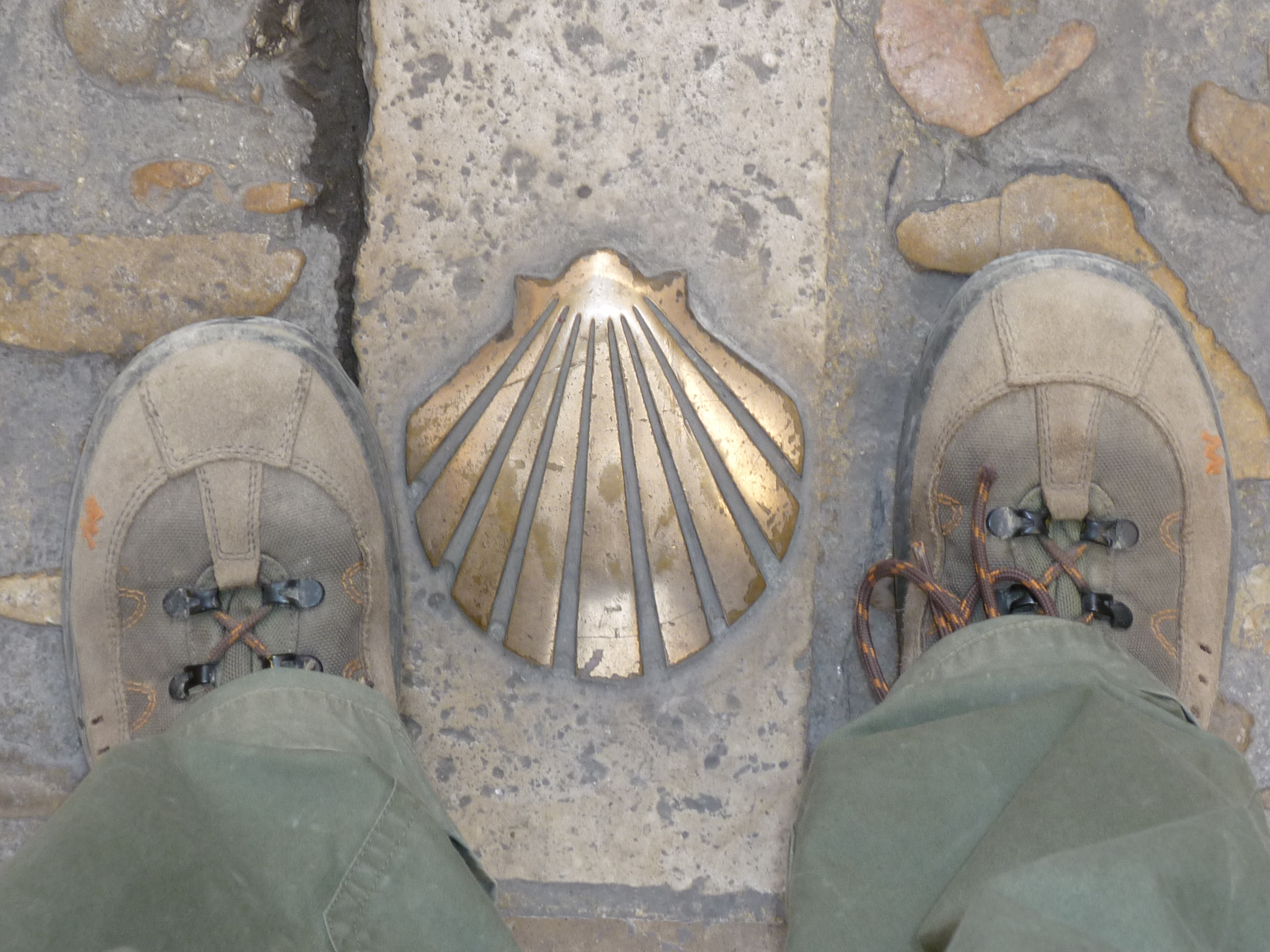
I lace up my shoes and follow
from a safe distance
but it’s bound to happen His eyes will catch mine and I must summon the courage not to look away
for in His loving gaze questions arise memories hopes and fears
and we will carry them all to Jerusalem*
Jesus resolutely set out for Jerusalem. – Luke 9:51
Questions as you begin your Lenten pilgrimage:
What feelings does this poem or these images evoke in you?
What do they tell you about what you are carrying on your Lenten journey?
Credits: Photo of hiking boots and scallop shell on the Camino de Santiago de Compostela from Paulo Coehlo forum. Labelled for reuse. “Pilgrimage of Sight” by Brian Whelan was featured in explore, a magazine from the Ignatian Centre of Jesuit Education in Santa Clara California. The painting is owned by the vicar of Blythburgh Church in Suffolk, UK. Used here with permission.
“Pilgrimage” by Esther Hizsa from Stories of an Everyday Pilgrim, 2015.
Pain. Sharp, deep and relentless. That’s what I feel when I’ve been treated unfairly. I keep wondering why they did that to me?
I can imagine that it’s hard for them to admit they made a mistake. If I confronted them, they would probably justify their actions and distance themselves from the impact. Even if they could see what they did wrong, apologizing might be as far as it goes. Say they’re sorry, and it’s done without looking, without really seeing how they hurt me.
Forgiveness comes slowly and releases an event from having the power to define me or keep me in a “How could they?” loop of anger. I let go of blame, have compassion for myself in moments that I can’t, and allow the wound to hurt until it heals.
I’ve been a victim, and I’ve been a perpetrator. In small and big ways, I’ve hurt others too.
It’s true. I know it theoretically, but when I’ve dared to look specifically at how I’ve wounded another–when an incident has come into the light–it’s too bright for me. I turn away. I can’t stand the blame and the thought that I was a bad person who did a bad thing. Even now, as I write about it, I feel anxiety in my chest and shoulders.
But Truth wants to be seen. Time passes; it waits.
When I dared to look again, I had more ground under my feet, more understanding and compassion for myself. I did the best I could. If I’d had the capacity to do things differently I would have. Tears came. I felt sad that I wasn’t able to be kinder and more proactive and sad that others were harmed as a result.
More time passed. Truth patiently waits to show me more.
Once again, I’m faced with the reality that others still carry deep wounds because of what I’ve done. Since the last time we went down this road, I’ve learned to let go of blame. I know that many people contribute to a hurtful event, not just the perpetrator and the victim and their dispositions and life experiences, but all those who influenced them–generations of misbeliefs and harmful habits. I can let go of being responsible for another person’s pain whether I contributed to it or not. It’s theirs. They’re on their own journey of forgiving and discovering that their healing doesn’t depend on my actions.
As more time passed, I realized that even after I’ve owned what I’ve done and made different choices, those I’ve hurt may still see me as a bad person, even if they don’t want to. It may take a long time for their wound to heal and for them to let me come close.
That’s so painful for me because I want to come close. I want to be seen as good and loving. I’ve made amends for the past, and there’s nothing more I can do. But I want to do more. I want to make them believe that I’m good, but that’s a deep hole I can’t fill. It’s also all about me and what I need.
God invites me to welcome my pain, feel how it expresses itself in my body, sink into it, allow it to be there and rest in another Truth: that I’m good.
God calls me good, even though I make bad choices sometimes. My ego categorizes some people as good and others as bad. Believing I’m better than others and could never be as bad as so-and-so bolsters my self-esteem. But I’m no better or worse than anyone else–even if, in their pain, someone sees me as bad.
Days pass. What comes into the light now is even more painful than being thought of as bad. I still have not looked at, really looked at, the pain another carries because of my choices. I’ve cried, but I haven’t cried for them.
They don’t need that from me for their healing–although I’m sure it would mean a lot to them–but I need to do it for my healing, to reconcile me to myself and others.
There’s a cave in my chest lined with sharp, jagged rocks. I see myself as a wolf, pacing back and forth in it, unable to lie down. Truth pokes and pierces.
For a long time, I’ve been unaware of this cave and just kept moving. Decades ago, whenever I tried to lie down in it, it was so painful I’d black out in depression. Eventually, I learned to peek at the cave from a distance. I put it in a room, shut off the light and only looked at it when I felt safe.
But I don’t want to put it back in the dark where the cave doesn’t change. It needs to be in the light, and I need to rest.
I open my eyes and see the sharp rocks overhead, on the walls and under my feet.
Love comes to me and says, “This is hard.”
Love paces with me–has always paced with me–never leaving my side.
Love sees I’m exhausted. I need to lie down; I need to let reality pierce me. Love lies down with me on the sharp surface. We are both pierced down one side. Love never takes Her eyes off me.
I remember what it was like to be hurt by others, how it accused, crushed, and abandoned me. This cave is made up of all the times I’ve done that to another. I see how my actions have caused them to suffer, and I feel for them. If I came in here without compassion for myself, carrying blame and responsibility, I would bleed to death. It’s good I didn’t come here too soon.
It’s a hard place to be, having compassion for another. I can’t move without being pierced in a different place. But I’m not alone. Love feels it with me, breathes it into Herself.
I can’t stay in the cave long, nor do I need to. But in these moments when I find myself here, I need to stay, feel and look into the eyes of Love.
I breathe in our pain and breathe out compassion for them and for me.
Forgiveness is for the victim, reconciliation for the perpetrator.
–William Paul Young
There were three spiritual practices embedded in today’s post: The Welcoming Prayer Practice, Tonglen and spiritual direction. In the video clip above, Cynthia Bourgeault explains Welcoming Prayer. You can also learn more about it from Contemplative Outreach. I love this podcast about Tonglen by Pema Chodron. Although she explains it as a Buddhist practice, Christians can do it by breathing in suffering into Christ at the core of our being and breathing out Christ’s love, compassion, peace, healing etc to others, the world or ourselves. The image of the cave and myself in it came when I was in spiritual direction. The feelings I am often too afraid to feel come out when I’m accompanied by my director who holds a compassionate, safe place for me to voice my fears, feel them and find God loving me in them.
Credits and References:
“Hurt by PierreKarl Schnyder, Used with permission.
“Reconciliation by Josefina de Vasconcellos at Coventry Cathedral” by Ben Sutherland. Used with permission.
Quote from Wm Paul Young at Embrace retreat, St. Dunstan’s Anglican Church, Aldergrove, B.C. 2019.
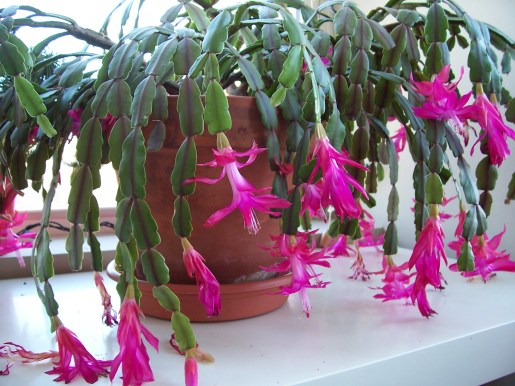
“I’m so sorry!” I said to my Christmas cactus when I brought it home from my book launch in November.
I wanted to brighten the room by putting some flowers on a table behind me when I was being interviewed. I could have bought cut flowers, but my bushy Schlumbergera was in full bloom and gorgeous. Plus I’ve written about it a number of times on my blog.
Fred prepared a place for the large plant in the back seat of the car and strapped it in. I sat beside it to keep it steady, but as soon as we got to the church, I knew it was a bad idea. Strength seemed to have drained out of it, and all its branches drooped.
A week later, it still had not returned to itself, so I used some ribbon to tie the weaker branches to a heartier one. The last bloom fell when Advent began.
For years now, my Christmas cactus has bloomed in Advent and given me hope in the dark season of waiting. But last year, it had no words for me.
Tiny buds appeared mid-December, but when I touched them they dropped to the floor.
“I’m so sorry,” I said again.
I watered my friend, gave it fertilizer and felt deepening respect for my Schlumbergera. In January, new buds appeared and are now blooming.
“Look at you!” a directee said beholding the flowering beauty.
“I’ve been forgiven,” I replied and told her the story.
What I didn’t say was that my dear Christmas cactus hadn’t revived to wag a finger at me. Although it wanted me to know that it didn’t like being moved, it bloomed because I needed hope.
I needed to be reminded that we do things that hurt others, and it can take a long time to be forgiven.
Meanwhile, Love forgives me, and Love asks me to forgive myself.
I don’t know if I continue, even today, always liking myself. But what I learned to do many years ago was to forgive myself. It is very important for every human being to forgive herself or himself because if you live, you will make mistakes–it is inevitable. But once you do and you see the mistake, then you forgive yourself and say, “Well, if I’d known better, I’d have done better,” that’s all. —Maya Angelou
“Valarie Kaur is a seasoned civil rights activist, award-winning filmmaker, lawyer, faith leader, and founder of the Revolutionary Love Project. She was born and raised in Clovis, California, where her family settled as Sikh farmers in 1913. When a family friend was the first person killed in a hate crime after September 11, 2001, she began to document hate crimes against Sikh and Muslim Americans, which resulted in the award-winning film Divided We Fall. Since then, she has made films and led story-based campaigns on hate crimes, racial profiling, immigration detention, solitary confinement, marriage equality, and Internet freedom. . . During her work, whether inside supermax prisons, on the military base at Guantanamo, or at sites of mass shootings, she identified a surprising key element for social change: the ethic of love. Today she leads the Revolutionary Love Project to champion love as a force for justice and wellspring for social action.” valariekaur.com/about-valarie/
Credits and References:
“Happy Cactus” by spablab. Used with permission.
Photo of blossom of the Schlumbergera (Christmas Cactus) from Wikipedia Commons.
Maya Angelou quote from The Amazing Fitness Adventure for Your Kids: 90 Days to Raising Healthy Children, by Phil Parham and Amy Parham, September 1, 2011.
Someone else
missed out.
Someone else
didn’t know.
Someone else
had to find out on their own that
they were enough.
I didn’t know I was
lonely
until this me-too
came along.
Now I know that
loneliness feels like
not being at home in your own house
not knowing how to pump gas or peel potatoes
being lost in the dark
and forgetting the sound of a loved one’s voice.
Loneliness is waking up to find
there is no Mrs Nelson
or even worse.
There is
but you were absent the day she said everything
your heart wanted to hear.
Thank God for poems.
They are Mrs Nelson.
They come
to where you are.
With That Moon Language
Admit something: Everyone you see, you say to them, “Love me.” Of course you do not do this out loud; otherwise, someone would call the cops. Still though, think about this, this great pull in us to connect. Why not become the one who lives with a full moon in each eye that is always saying, with that sweet moon language, what every other eye in this world is dying to hear.
–Hafiz
Poetry Unbound is a new series from On Being that invites you to “immerse yourself in a single poem, guided by Pádraig Ó Tuama. Short and unhurried; contemplative and energizing. Anchor your week by listening to the everyday poetry of your life, with new episodes on Monday and Friday during the season.” Pádraig Ó Tuama, is a poet and theologian who leads the Corrymeela community of Northern Ireland, an ecumenical community dedicated to reconciliation.
Day 23 of Home, a 30-day yoga journey with Adriene. The theme for today is focus. We return to rest after a challenging pose that has stretched us. Adriene asks, “Where in your body is your attention drawn? Focus on it. Energy will automatically flow there.”
Once again, Adriene goes on to relate this to our lives. “What are you focussing on today? Where do you want your energy to go? Where attention goes, energy flows.”
I think about the day ahead and watch it unfold as if I’m standing at a railway crossing. I watch one moment after another come into view and pass by coupled to the next and the next and the next. I don’t see the conductor, and after a while, I don’t see the cars–just a blur of rusty red and green and words that mean little to me.
I watch as if I have little power, few choices. Things have to be done, so I get to it.
But right now, I have a spacious moment. No train. No noise. Nothing urgent pulling at my pant leg. What do I want to focus on today?
Presence. God’s presence. I want to open to God, in this moment and the next.
As I name that intention, I realize I don’t want to just focus on God being present to me, but God present in others. In the Radical Compassion Challenge, Tara Brach says that we see some people as real–those who are dear to us–and others as unreal, stick figures. We don’t really see these people. They fulfil a function but don’t really exist for us–the woman who doesn’t speak English, the man who delivers our mail, the child making a fuss in the grocery store. Tara invited us to awaken and see them as real people.
Today I want to notice who is not real to me, who is a nameless car on the train of life. I want to see them, give them attention, and let my energy flow to them–even if it is just for a second. In that second, I have the power to make them real.
“Real isn’t how you are made,” said the Skin Horse. “It’s a thing that happens to you. When a child loves you for a long, long time, not just to play with, but really loves you, then you become Real.”
“Does it hurt?” asked the Rabbit.
“Sometimes,” said the Skin Horse, for he was always truthful. “When you are Real, you don’t mind being hurt.”
“Does it happen all at once, like being wound up,” he asked, “or bit by bit?”
“It doesn’t happen all at once,” said the Skin Horse. “You become. It takes a long time. That’s why it doesn’t often happen to people who break easily or have sharp edges, or who have to be carefully kept. Generally, by the time you are Real, most of your hair has been loved off, and your eyes drop out, and you get loose in the joints and very shabby. But these things don’t matter at all, because once you are Real, you can’t be ugly, except to people who don’t understand.”
Mother Teresa said, “If we have no peace, it is because we have forgotten that we belong to each other. ” The challenge for Day 8 in the Radical Compassion Challenge was to wake up from bias by talking to a person who identifies differently than you do. We have no idea what it’s like to be them unless they tell us. If we offer open-hearted interest, perhaps we will get a window into their world and their heart . . . and ultimately into ours.
Credits and References:
BNSF Cajon 4 by John Mueller. Used with permission.
Image from The Velveteen Rabbitby Margery Williams, 1922 [Public domain] from Wikimedia.
Picture of girl from pxhere. CCO Public Domain.
What if
the bus is late?
What if
I get to the airport
and the planes don’t fly
and the buses don’t run
and I’m stuck at the Kelowna airport
which isn’t in Kelowna.
It takes a while to sink into
“I will be with you always.”
and
“I have called you by name,
you are Mine.”
I take a deep breath,
let it out slowly.
I open to the possibility
of things going differently
and all being well.
All shall be well, and all shall be well and all manner of thing shall be well.
–Julian of Norwich
It’s not too late to join the Radical Compassion Challenge hosted by Tara Brach. It’s free from now until January 30. Each day includes 1) a teaching session and guided meditation on topics such as embodied presence, self-compassion, and self-forgiveness, 2) a daily compassion-in-action assignment, and 3) interviews with 10 thought leaders and visionaries such as Jon Kabat-Zinn and Krista Tippett. I particularly like Tara Brach’s RAIN meditation which is similar to the Welcoming Prayer.
Credits and References:
“Pieta House” by Joe Houghton. Used with permission.
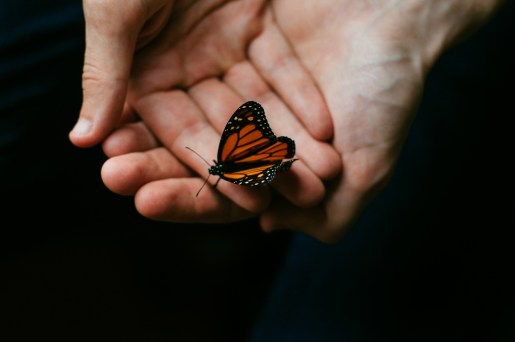
Butterfly photo from pxhere. CCO Public Domain
Compassion image by Susan von Struensee. Used with permission.
“Why don’t we wait until the snow melts and see if your wallet is there,” our daughter said, looking at a snow-covered patch of grass we couldn’t shovel. “I’ll keep an eye on it. No one’s going to find it under all that snow before we do.”
It had been fourteen hours since my wallet went missing, so I wasn’t as frantic about losing it as I first was. The day before, we had finished having dinner at our daughter’s house and looked out the window to see if the predicted snowfall had started. It hadn’t. But an hour later, when we finished playing a board game, so much snow had fallen that the roads were impassable, and Fred and I couldn’t drive back to our place, 3 kilometres away. During our attempt to get home, I discovered both my cell phone and wallet were missing.
We left our car at our daughter’s and walked through the snow to the Skytrain. In my mind, I retraced my steps from when I’d last had my wallet and phone in my hands until I noticed they were missing. How could I have lost them?
Google Timeline showed that my phone was still at our daughter’s place. There was no action on my phone or on my credit cards. No one had stolen them. But where were they? Our daughter and her husband looked for them again, but it was difficult in the dark.
Meanwhile, it continued to snow.
At five in the morning, we received a text. Our daughter’s tenant had found my phone outside their house. I went back to sleep and in a wakeful moment, sensed God’s comfort. Whether I found my wallet or not, it would be all right. Finally, what I knew in my head, my heart believed.
I returned to our daughter’s place in the morning, and we continued the search for my wallet. When our efforts were fruitless, I decided to wait until the snow melted and trust her watchful eye. In our coastal climate where snow can come and go within days, I wouldn’t have to wait long.
It wasn’t safe enough to drive our car home, but I could clear snow off the roof and windshield. There, on the floor on the front passenger side, was my wallet. It must have fallen out of my backpack when I was looking for my phone the night before.
I enjoyed the relief I felt as I walked home along the Brunette River. The ground, bushes and branches were covered with thick, soft snow. Beauty hushed my soul and ignited a childlike delight in this fresh, white world. While I was glad I’d found my wallet, my mind returned to the thought that the snow would keep something of mine safe, and I could trust that Love would wait and watch for me.
That was on Monday. More snow days followed with events cancelled and spaciousness lavishly given. I didn’t have to wedge my life between deadlines. I love the slow pace of waiting to see what treasure will be revealed and knowing that God is keeping a watchful eye out to celebrate what’s found.
If it were not for You, O Beloved, You who make all things new, Fear and chaos would reign in every heart; in You will I trust forever.
–Psalm 124:1,2
Nan C. Merrill, Psalms for Praying:
An Invitation to Wholeness
Credits and References:
“Snowfall” by Ed Suominen. Used with permission.
Snowy Trees” by broombesoom. Used with permission.
Photo of the Braacx family used with permission.
“There are so many moments in our yoga practice when we have a chance to be humbled and for it to be a positive experience versus something we’re just trying to blow through. So . . . activate your humility,” Adriene said on Day 4.
Her gentle voice stayed with me as I thought about what was difficult for me right now. This Saturday at Living from the Heart, I will be presenting material that I have heard a number of times but haven’t taught before. It takes time and intentionality to find my voice and let it shape the words and concepts I want to convey.
The subject is the False Self and, not surprisingly, I’ve become a work in progress. My false self wants to have the material down with a gratifying fluidity. It’s important to put the effort in so that participants comprehend this slippery concept. But what if “nailing it” isn’t within my grasp?
Ooh. I felt something as I wrote that. My heart space softened and up crept a hint of tears. What’s going on? I wait and then the words come: I recognize a tense desire to do it perfectly and a relief that it’s okay if I can’t.
I smile as I recall a quote I will be sharing on Saturday. St. Augustine once said, “There are three things that are the most important in the Christian life. The first is humility. And if you ask me, the second is humility, and the third is humility.”
This morning I unrolled my mat and met Adrienne on Youtube for Day 5 of my 30 day yoga journey. Today’s word was Soften. Adriene asked, “Are you working harder than you need to?” And then, as if she were reading my mind, she added, “Not just on the mat but in your life?”
What if I soften my expectations, prepare adequately and then activate my humility? What if I trusted that Brent and Audrey, my co-facilitators, will fill in the gaps needed? Or trust that if participants leave with questions unanswered that living those questions will be better than having all the answers.
Adriene offers this pro-tip: “Activate your breath–and let it do the work for you.”
Yes. Breathe in Ruach. Breathe in the Breath of God–loving all, sustaining all, enlivening and transforming all. Activate your humility. Trust that Breath.
The Spirit of God has made me; the breath of the Almighty gives me life.
–Job 33:4 (NIV)
As of January 1, 2020 business license holders in Vancouver are no longer permitted to serve prepared food in foam cups and foam containers. Vancouver banned the use of styrofoam in a movement toward becoming a waste-free city in 2040. Next to be banned will be plastic drinking straws. This ban will take effect on Earth Day (April 22, 2020). People in Vancouver will still be able to buy styrofoam containers and plastic straws for personal use. But we don’t have to. If we stop buying them, stores will stop selling them. Every small step we take to care for the earth counts.
Credits and References:
“Yoga girl” by Todd Dailey. Used with permission
“Flood Tide” by SwaloPhoto. Used with permission.
Image of styrofoam containers from FastCasual.
“When you turn to your partner for the next part of the dance, don’t make a meal of it. There’s another partner waiting to greet you. The Divine in them and wants to bless the Divine in you,” Allaudin (aka Sandy) instructed at the Dances of Universal Peace.
By the time the song was over, I had danced with half the people there–everyone that was going in the opposite direction around the circle. A few I knew well, but many I didn’t. The dance invited me not to play favourites but to treat each partner equally and honourably.
A similar “dance” happens every Sunday as we pass the peace in church. I turn to each person, look them in the eye, shake their hand or hug them, and we say to each other, “The peace of Christ be with you.” I don’t scoot around to my favourites. For this dance, we share God’s reality that we are all favourites.
This feels so counter-cultural in a world where we choose special people to receive Christmas cards, gifts or invitations to dinner. We collect BFFs on Facebook. The unstated message is that we are somebody if we have at least one best friend.
I don’t. Not counting Fred of course. Many of my friends enjoy best friends, but I’m not their BFF. I felt a little melancholy about that until I remembered that God gives me everything I need. If I need a BFF, God will assign me one. Years later, although I have very good friends, I still don’t have a special one that rises above the ranks of the others.
When I attended my first Dances of Universal Peace, I looked around the room of strangers to see which ones I might connect with. Without a second thought, I categorized people into those I thought would be more interesting (or, if I’m honest, more interested in me) and the others who would be ignored. But the partner dances didn’t bow to my ego or listen to my worries about fitting in. They didn’t ignore anyone.
We were all part of the dance. God was incarnate in each of us, and together we sang and clapped, stepped and twirled that reality.
They are all God’s favourites–every single one of them. Could they be mine as well?
This is what God does. He gives his best—the sun to warm and the rain to nourish—to everyone, regardless: the good and bad, the nice and nasty. . . . Live out your God-created identity. Live generously and graciously toward others, the way God lives toward you. –Matthew 5:45, 48
Dances of Universal Peace are embodied prayers. When I pray with my body something good happens at a deep level that I don’t understand. It makes me curious about what else I have been missing out on. A friend sent me this link to an On Being podcast in which Krista Tippett interviews Bessel van der Kolk about how trauma lodges in the body. It was fascinating to hear how movement can bring healing in ways that talking doesn’t. Both Tippett and van der Kolk had high praise for yoga. Another friend put me on to Yoga with Adriene, and I’ve started the 30 Day Yoga Journey. Adriene says, “Yoga offers up a way for us to see a world that is working for you instead of against you. Yoga reminds me that everything is connected so we must live, act, breathe with awareness.” I feel like the Spirit has led me here. What wonderful love mischief.
Credits and References:
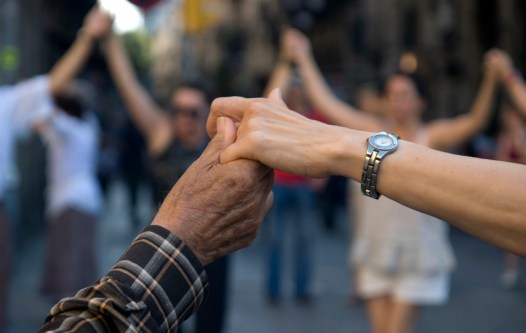
“Dancing the Sardana” by chany crystal. Used with permission.
Kinderreigen (1872), Hans Thoma [Public domain], via Wikimedia Commons
I don’t like disappointing people, missing out on opportunities, and not being where the action is. Saying yes gives me a sense of purpose and solidifies my identity as a valuable person.
It can also leave me exhausted with little space in my life to rest and be kind to my body. Rushing from one thing to the next lessens the enjoyment of what I’m doing. More and more I notice that I like checking some things off my list more than actually doing them.
I’ve been discerning whether to take another year off from directing the Ignatian Spiritual Exercises in Daily Life with the Jesuit Spirituality Apostolate of Vancouver. It’s good work that I love doing, but it takes a fair bit of time and energy.
When I thought about saying no I realized I was afraid. I was afraid of disappointing people, missing out, and letting go of a solid part of my identity.
But as I held that no in my hand longer and imagined letting it go, I felt more than fear, I felt liberated. I felt like God had put another Saturday in my week.
So I said no.
Then I said no again to something else I thought about doing even though I know someone will be disappointed.
“I need to disappoint people more,” a directee of mine said recently. He has embraced this new freedom as a divine invitation.
I think I can too.
Ask [God for the grace] to be free enough to be influenced only by this one value: which alternative will give most glory to God and be expressive of my own deepest self, my authentic self? –Jim Manney, SJ
Jim Manney, SJ outlines a step-by-step process of discernment for decision-making that Ignatius of Loyola included in his spiritual exercises. Perhaps you’ll find something helpful in it when you have to make a decision. I am so grateful that God is glorified when I listen to my deepest self.
Credits and References:
Just say no is from pixabay. Creative Commons.
Indecision by madamepsychosis. Used with permission.
Image of doors form pxfuel. Creative Commonss

 Jesus resolutely set out for Jerusalem. – Luke 9:51






 Mother Teresa said, “If we have no peace, it is because we have forgotten that we belong to each other. ” The challenge for Day 8 in the





 An Everyday Pilgrim