“I have wonderful news: the Hoped-for-One, the Birthing you’ve longed for in the depths of your soul, has come, oh yes, has come!” — Joyce Rupp
Really? I can’t see it happening. I long to be birthed into long stretches of unrattled moments, moments of ease and wholeness untinged with disappointment.
Will Your coming calm the sea of my life free me from my paralyzing thoughts satisfy my hunger? This wafer is so small, this wine, only a sip.
What do you hear in the depths of your soul, My love? There is a deeper longing. Listen.
Then I saw it and felt you nod and smile. The gift of Emmanuel– God with us.
You are with me in every passing moment holding my hand opening my eyes to see in each rattling the seed of a miracle.
What is being birthed is the freedom to choose to turn away or turn to wonder.
When the going gets rough, turn to wonder. –Parker J. Palmer, Circles of Trust
Credits and References: “Angel and Shepherds” by Howard Stanbury. Detail from stained glass in the chancel window, St Mary, Adderbury NEX-3 and Minolta Rokkor 135mm f/2.8 Joyce Rupp quote from “Keeping Watch in the Night” in Out of the Ordinary Poem “Turn to Wonder” by Esther Hizsa, 2022. “Nativity Scene” by Berit Watkin. Used with permission.
As I began my four-day retreat last week, I became aware of how uncomfortable I was with the silence–especially in the evening when it was dark, and I couldn’t go for walk or gaze at the sea. I wanted something to occupy my mind so my mind didn’t occupy me with endless rabbit trails of thought or, worse still, unkind thoughts that won’t go away.
On the morning of the last day of my retreat, I prayed with the gospel narrative of the healing at the pool. Even though I entered into this miraculous story, I got caught by how it ended. Jesus told the man, “Stop sinning or something worse may happen to you.”
For the life of me, I couldn’t imagine Jesus saying this kindly.
I ruminated about it as I walked the hilly roads on Bowen Island and as I sipped tea and looked out at the ocean.
I know that when we pray with our imaginations, what unfolds doesn’t have to follow the gospel story. God meets us in our story. I also know that if we encounter a Jesus who is harsh, it’s likely a false image of him. I remembered, too, what Father Richard Soo said to those praying the Ignatian Spiritual Exercises. He said, “When the Holy Spirit convicts me of sin, I feel loved. If I feel condemned, that’s another voice, not God’s.”
I knew all this, and yet, I couldn’t shake the belief these words were meant for me–that God was tired of my neediness. It was the Bible, after all. And this was what the Bible was saying to me.
Finally, in the long dark evening, I told God, “I can’t stop sinning.” My eyes filled with tears.
Then, I said, “If these words are not for me, let me hear your words, your voice. Tell me what’s true.”
Woo Young Woo is a twenty-seven-year-old lawyer with autism. In the first episode, she meets Lee Jun-ho, who works in the law firm’s litigation department. He’s smitten with her. In Episode 11, Attorney Woo recognizes she has feelings for Jun-ho and keeps looking at him through the window in her office. And this is what happens.
As I recalled the scene, I sensed God reaching out to me and loving me just as I am. Tears flowed. I felt known and deeply loved. I soaked in that love for a good long time. The dark empty evening that had seemed so challenging now provided the spaciousness to enjoy this exquisite moment.
Silence was not a barrier that kept me from God but a window of encounter. And what a lovely encounter that was.
Silence is a window to the soul, and the soul is a window to God. —Fr. Christopher Jamison, Worth Abbey, UK
∗ ∗ ∗
Advent 4 Reflection
Take a few moments to be with the words and images in today’s blog post.
What draws you or disturbs you as you wait in silence with God?
What thoughts, feelings and felt senses arise as you welcome or resist this awareness?
Imagine God listening and feeling what you feel. What do you sense God offering you in this moment?
As we wait in Advent for the coming of Christ, we sing, “O come, o come, Emmanuel and ransom captive Israel. That mourns in lowly exile here until the Son of God appears.” May Christ find you in the exiled places of your life and bring you home to God’s heart.
Credits and References: “Silence” by frank_hb. Used with permission. “Starry Sky Stock” by Parée. Used with permission.
And Jesus said to him, “Foxes have holes, and birds of the air have nests, but the Son of Man has nowhere to lay his head.” –Luke 9:58 (NRSVUE)
I want to lay my head on the satisfaction of believing that what I do is a gift to others and gives glory to God.
But reality whisks that pillowy thought away when I’m rudely awakened by the truth of how my helpful tendencies are no help at all.
Then, like Jacob on the run after deceiving his father and lying to his brother, I find myself outside the city gates, resting my head on a rock. Yet, that night You came in a dream– angels ascending and descending on a stairway to heaven. “Surely God was in this place, and I did not know it,” Jacob said.
When I lay my head on a pillow it turns into a rock, and that rock becomes a pillow
until it changes again.
I’m both– helpful and unhelpful healer and wounder disabled and gifted human and divine
and in the tension I find my suffering and my salvation.
You have made us for yourself, O Lord, and our heart is restless until it rests in you. — St. Augustine, Confessions
.∗ ∗ ∗
Advent 3 Reflection
Take a few moments and be with the words and images in today’s blog post.
What new awareness has awakened you to an unhelpful tendency in yourself that causes suffering in you or others?
What thoughts, feelings and felt senses arise as you welcome or resist this awareness?
Imagine God listening and feeling what you feel. What do you sense God offering you in this moment?
Jesus said, “Come to me, all you who are weary and burdened, and I will give you rest.” (Matthew 11:28) As you open to Jesus’ invitation, how is God saving you?
Credits and References: “The Restless Sea” by Kain Kalju. Used with permission. Poem “Restless” by Esther Hizsa, 2022. Jacob’s dream is in Genesis 28:10-16 “071020” (Baby) by Tamaki Sono. Used with permission. Nativity” by Stephen Brent. Used with permission.
Life is a succession of dyings and risings. At the center of the Eucharist, we proclaim, “Christ has died, Christ is risen, and Christ will come again.” –Richard Rohr’s Daily Meditation, November 27, 2022
This morning I saw minuscule buds on my Christmas Cactus.
Last year’s $5.99 Walmart purchase has a long way to go to replace the glorious plant that got me through many winters.
Like you, perhaps, Advent makes me keenly aware of what I used to have and can’t get back– the loss a cold draft that keeps finding its way in no matter how often I close the door.
It’s getting darker in the northern hemisphere but on December 22 there’ll be a little more light, on December 25 even more.
After death comes resurrection.
New buds. Warm breath. Light.
Can I trust the ancient rhythm? Can I trust the Ancient One Who came, is coming, will always come even if I don’t know how or when?
I cannot tell you how the light comes, but that it does. That it will. That it works its way into the deepest dark that enfolds you … —Jan Richardson, “How the Light Comes”
∗ ∗ ∗
Advent 2 Reflection
Take a few moments and be with the words and images in today’s blog post.
What have you lost?
What thoughts, feelings and felt senses arise as you welcome or resist this?
Imagine God listening and feeling what you feel. What do you sense God offering you in this moment?
Where have you noticed signs of resurrection?
Credits and References: “Bud developing” by Steven Severinghaus. Used with permission. “Candle 006” by Jonathan Assink. Used with permission. Poem “Trust “by Esther Hizsa, 2022. “The Glory of Dawn” by worldoflard. Used with permission.
I waited for You at the door of words but they were little more than letters on a page undecipherable
my feelings far away. Did I have any?
I fidgeted distracted powerless.
Then, through the locked door, You came.
“Touch my face,” You said
Lost feelings found tears.
Fingers found skin cheek and chin. Yours and You leaned –ever so slightly– into my palm.
In Your face my fingers found my belovedness and then they found every face I longed to touch– one gone one far away one forbidden another entombed and others right here in my everyday life.
I reached out and touched them all.
This gesture so loving, so intimate breaks the rules undoes the hardest heart exposes and meets us. You can’t just touch people’s faces like this. It’s not allowed.
But it’s allowed here in my prayer.
That wonderful wordless touch has the final say on who we are.
And the Word became flesh and dwelt among us. –John 1:14 (NSVCE)
∗ ∗ ∗
Advent 1 Reflection
Take a few moments and be with the words and images in today’s blog post.
What are you drawn to?
What thoughts, feelings and felt senses arise?
Imagine God listening and feeling what you feel. What do you sense God offering you in this moment?
What might be your Advent prayer?
Credits and References: Sgt. Brian Prescott, of the New Hampshire National Guard’s 3rd Battalion, 197th Field Artillery, smiles as his nine-month-old son touches his face during a welcome home ceremony at the Manchester armoury on Dec. 20. Prescott, who had last seen his son when he was born, was among the first wave of 3rd Battalion soldiers to return to N.H. after completing a Middle East deployment in support of Operation Spartan Shield. Photo by The National Guard.Used with permission Poem “Touch “by Esther Hizsa, 2022. “Touch” by Sarah Barker. Used with permission. “And they found baby Jesus laying in a manger” by Percita. Used with permission.
I grew up in rural Ontario and attended Wellburn United Church which was part of a three-point charge. I remember the aisle I walked down on my wedding day, the pew where I received my first communion, and where the choir sat. At thirteen, my friend Edith and I were so proud to be the youngest choir members. I recall the back stairs leading down to the basement and the hall where bridal showers and church dinners were held.
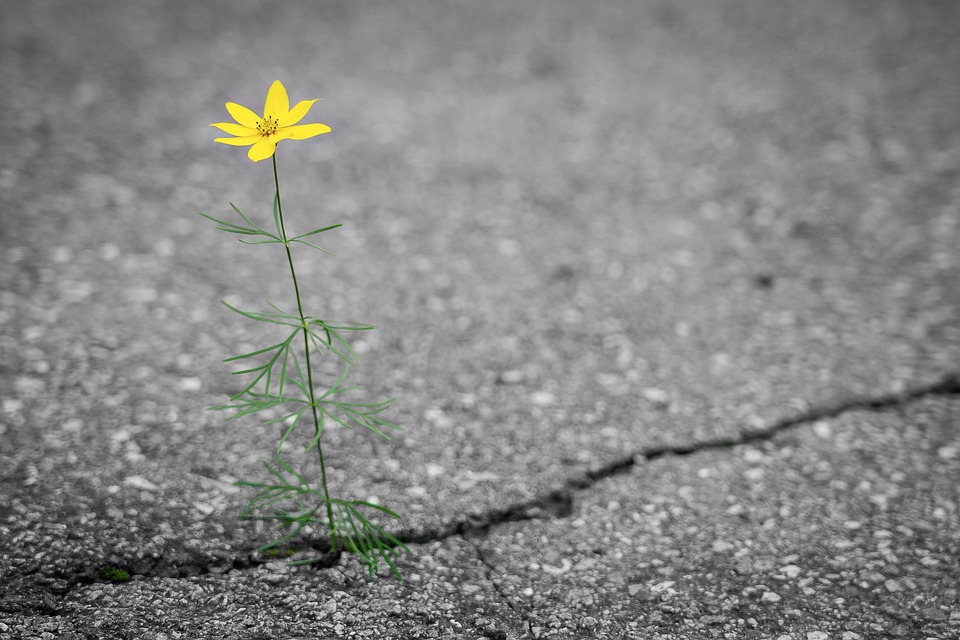
In that hall, there was a big framed picture of Jesus—a classic with little children from around the world sitting near Jesus or on his lap. Next to it was a 99-cent poster with the image of a flower growing out of the ground and these words in bold letters: “Bloom Where You Are Planted. ”
Bloom where you are planted.This imperative from long ago invites me to embrace where I am, be who I am, and flourish.
This is a challenge for me when I find myself discontented with where I find myself sometimes. How can I bloom here in this moment, in these circumstances? Yet, I don’t hear God asking me to shove my feelings aside and put on a happy face. I hear possibility. Even in this difficult place, there is joy.
Sometimes, when I was a teenager, I’d ride my bike to the church on a Saturday afternoon. I knew where the key was and let myself in. Alone in this sacred place, I shared my thoughts and feelings with God, I sang and listened to my voice fill the sanctuary.
Now I know that sacred place is not only in my church, but it’s also inside me. At any moment, I can return there–not to escape reality but to see something wonderful in it.
I’ve been doing that lately, and I find myself feeling more settled, more joyful, and a little more like maybe I could bloom right where I am.
If my joy is contingent on circumstances that bring me happiness, my joy will go up and down, and up and down. But joy is a deeper thing. It does not have its source in circumstances that happen to me. It has its source and origin from something within me. –Bishop Micahel Curry, in an interview at the Joy Summit.
This coming Advent season, how might we enter the story again, this age-old familiar story, and allow it to help us pay attention to our stories? How might we be watching for the Light in our ordinary everyday vulnerabilities, and how might we do that with one another?
Settling in with poetry and scripture and art, join spiritual directors Doug Schroeder and Deb Arndt as they host four evenings on the Advent journey. You only need bring yourself, your longings and your honesty and your beautiful, messy story. We’ll travel again through Advent, then and now. In this quiet contemplative space, let’s watch together for the Light.
DATES: Monday evenings November 28, December 5, 12, 19 on Zoom.
TIMES: 6:30-7:30 PST; 7:30-8:30 MST; 8:30-9:30 CST; 9:30-10:30 EST
Through our God’s heart of mercy, the Sunrise from on high will come upon us, to give light to those who sit in darkness and in the shadow of death, to guide our feet in the way of shalom. —Luke 1:78-79 (TVL)
I looked out at the vast ocean and up at the big blue sky as Fred and I walked the aptly named Long Beach on the west coast of Vancouver Island. A few minutes later, we stopped to shed another layer of clothing, grateful for the warm sunshine.
“It’s not going to last,” I said.
It didn’t. Two days later, we were grateful for raingear. Instead of leisurely walks on the beach, we sought the shelter of cedar and salal and watched the waves crash on the rocks through viewpoints on the aptly named Wild Pacific Trail.
Weather systems come and go. We open to the sunshine and hunker down in the rain, but we don’t take it personally.
Yet when it comes to emotional weather systems, we take it very personally. But what if we didn’t?
I began to observe my internal weather systems, and here’s what I noticed.
One moment, I feel bad and wonder how to fix what’s wrong with my life. In the next, I feel fine. I love my life. There’s nothing to fix.
When I experience “bad” feelings, I want to get rid of them as quickly as possible, and that’s what I unquestionably set out to do. I was having a lovely life before these feelings showed up, and I want my lovely life back. I assume that bad feelings are telling me I’m doing something wrong.
I also noticed that when I was judged or someone crossed a boundary, I felt hurt, somewhat violated, and angry. I blamed the other person for making me feel this way and fixated on what I’d like to say to them so they don’t do it again. The idea that I had some control over future situations eased my feeling of helplessness, even though it won’t prevent similar situations from happening. I will feel this way again. I can’t prevent myself from feeling hurt, yet I keep trying. Henri Nouwen’s advice to befriend these feelings didn’t even cross my mind.
I was still thinking about weather systems–internal and external ones–on the day we left Ucluelet. That morning, we needed to scrape ice from our car, and snow had collected on the side of the road. We arrived at Departure Bay Ferry terminal in time to get the 10:40 ferry home. However, B.C. Ferries cancelled that sailing and the next due to high winds.
We headed to Duke Point a little farther down the coast and waited with hundreds of others who hoped to get on the 3:15 ferry to the mainland. Would B.C. Ferries cancel this sailing as well?
At 3:20, we watched the car count reach and pass the number that had fit on the previous ferry. Yet, we were signalled on and squeezed in.
I had no control over any of it. I could only choose how I would respond.
Welcome, welcome, welcome. I welcome everything that comes to me today because I know it’s for my healing. –Father Thomas Keating, The Welcoming Prayer
I offer you this photo I took in Florencia Bay. The roots of this washed-up tree were two to three times my height. Perhaps you would like to pray with this picture using the following reflection.
As you linger with this image, what do you notice? What draws you? What repels you?
Remain a little longer, welcoming both the sunny and stormy feelings that arise.
Imagine God’s loving presence beside you, feeling what you feel.
Look at the image again. Is there anything new that you didn’t notice before?
Stay a little longer there, allowing this moment, this loving God, this image to speak to you personally.
What do you sense God offering you for this moment in your life right now?
Credits and References: “Long Beach Vista” by Adam Jones. Used with permission. “Wild Pacific Trail, Ucluelet” by Kim Rollins. Used with permission. Image of washed-up tree in Florencia Bay by Esther Hizsa.
Of all my fears, the fear that I’m not a good mother tops the list. It came up again in a spiritual direction session after I revealed the latest incriminating evidence and added more tissues to the wet pile on my lap.
“What do you hear from God?” my director asked.
I closed my eyes and heard God’s soothing thoughts.
“I’m a mother because I have children,” I replied. “It’s just a label that describes a fact. The qualifiers ‘good’ or ‘bad’ seem meaningless to God. I’m simply a mother who loves her children.”
I felt the relief of those words settling in my body and thought about all the other labels I have: wife, spiritual director, retreat facilitator, writer, churchwarden, sister, friend. What would it be like to let go of measuring how good I am at those roles?
What do I take on to prove my goodness?
How much of my peace relies on being deemed good?
And what would it be like to be freed from the exhausting need to know I haven’t failed God, myself, or my children?
Questioning and measuring my goodness has been a lifelong compulsion. The fiery furnace of experience keeps confirming that I’m not good enough.
Yet, it’s being in the fire of other people’s judgments (or perceived judgments) over time that has begun to melt the hard metals used for or against me. Now I can see what remains is a Love that is only and always for me.
As I held this fresh thought, I recalled an image given to a directee of mine while on retreat. Her head was on Jesus’ lap, and he was stroking her hair and saying softly, “You can be who you are.”
For so long, I couldn’t rest until I was reassured of my goodness. Unconsciously, I believed there are bad people in the world, and I didn’t want to be one of them. I worked hard and took solace in scriptures that declared that all God made is good, and so am I.
Now God is inviting me to let go of self-judgment and the pursuit of finding security in my goodness. Instead, God is stroking my head and letting me know I can relax. Mother God doesn’t see me as a good or bad person. She sees the child she loves.
The Lord your God is in your midst, a mighty one who will save; he will rejoice over you with gladness; he will quiet you by his love; he will exult over you with loud singing. –Zephaniah 3:17 ∗ ∗ ∗
Wintering brings about some of the most profound and insightful moments of our human experience, and wisdom resides in those who have wintered. — Katherine May, Wintering
A Call to Wintering: Finding God in a Season of Dark Mystery and Starry Wonder An Ignatian Weekend Retreat Online
Is your heart calling you to encounter God in your wintering? Join Jan Evans and me online for a silent, guided prayer retreat on November 18-20, 2022. More details here.
Credits and References: “Measuring Up” by Kevin Friery. Used with permission. “Mother and Baby Maasai Giraffe ” by Mark Dumont. Used with permission. Photo of night sky creative commons license.
Did you notice that just now? That unexpected spaciousness in the midst of everything trying to get through the door at once. A delicious “Ahhhh!” A sense that it’s going to be fine. It is fine.
You keep thinking you need more days with nothing scheduled, more weeks of walking on the beach or puttering in the kitchen as if spaciousness only lives there and not here wedged between computer malfunctions and untimely requests.
You only need to put your mother-hands on your heart or cup your face with your child-hands, take a deep breath and let your heart come down from the ledge your mind notice its thoughts your body remember its wholeness.
All you need at this moment you already have.
Did you hear that just now? That skeptical thought? Don’t shoo it away. Some part of you doesn’t quite believe Me but it wants to.
Hold that part of you in your mother-arms close your eyes and take it with you back into that spaciousness you felt just now.
You calm the roar of the seas and the noise of the waves. –Psalm 65:7 (GNT)
“Befriend your feeling of loneliness. Befriend that loss,” I heard Nouwen say in a recording of a talk he gave to a L’Arche gathering in 1994 entitled “Finding our Sacred Centre. Many years ago, reading Henri Nouwen’s The Way of the Heartset my heart on pilgrimage. I wrote about this profound experience in the opening chapter of Stories of an Everyday Pilgrim. So I was delighted to discover the Now and Then Podcasts. In these podcasts, Karen Pascal, executive director of the Henri Nouwen Society interviews spiritual writers, thinkers, and leaders who have been influenced by Nouwen such as Sister Joan Chittister, Brian McLaren, and Anne Lamott. There are also recordings of talks Henri Nouwen gave. What a gift.
Credits and References: “Calm & Chaos 11” by A K. Used with permission. “Calm” by Mike Green. Used with permission. Photo of Henri Nouwen Creative Commons.
You can’t change the past or control the future. What is is what is.
Feel your anger. Watch it rise up and look for someone to blame. Even if it is their fault or yours or God’s, it doesn’t change a thing. You’re still here. You still feel trapped, like the bottom has fallen out of your world.
Notice how you go over what happened again and again and again– what went wrong, what could have been done, what you would do next time. All this enlightenment may prevent life from repeating itself but it can’t undo this.
It takes time to make peace with your helplessness. But as you stay present there you discover it threatens but doesn’t kill knocks down but can’t destroy you.
Eventually you feel a softening, shift your weight and find a hidden strength that enables you to thrive right where you are
in the place you least expected to see yourself smiling.
We are afflicted in every way but not crushed, perplexed but not driven to despair, persecuted but not forsaken, struck down but not destroyed, always carrying around in the body the death of Jesus, so that the life of Jesus may also be made visible in our bodies. –2 Corinthians 8-10 (NRSVUE)
“Go and make peace with your helplessness,” Alfred Bell told his son, Steve, who was distraught when his father’s cancer returned. As Steve grieved the death of his father, a song came to him that he sang for his audience at Como Lake United Church last Friday. It was good to hear Steve in person again and let the love mischief of his stories and music inspire love mischief in me.
Credits and References: “Dove of Peace” photo by Don Sutherland. Used with permission. “Flower blooming during sunrise” by Viraj Shah. Creative Commons Licence.