I am made of the earth and of its Creator flesh and spirit human, divine impermanent and eternal.
I will die and before I die I will have died and risen again hundreds of times.
On the Saturday between Good Friday and Easter Sunday, I lay awake in the tomb and contemplated my death.
My body will die but my spirit will not and yet, I will need my mind (which is part of my body) to know that. And when my mind ceases to be, my knowing of that will also cease.
Then where will I be?
I felt myself fall out of my grasp
and found myself
held in the knowing of Another.
My being doesn’t depend on my knowing but on my being known
and I am –we all are– always known.
For you died, and your life is now hidden with Christ in God. –Colossians 3:3 (NIV)
Curious about Living from the Heart? Join my Maureen Miller and me online on May 24 for a mini retreat to experience what the Living from the Heart course is like and ask your questions. Register here.
Credits and References: “‘Just right!’ she sighed.” by Steve Corey. Used with permission. Known by Esther Hizsa, 2023 First published on my blog April 14, 2023. “Faith” (Detail from a window, showing Faith holding the lamp of the Spirit’s illumination by Burne Jones in Buscot parish church in Oxfordshire, England) Photo by Fr Lawrence Lew, O.P.. Used with permission. “Lovely Feet” by Amancay Maahs. Used with permission. Living from the Heart Image by Irene Fennema. Used with permission
We cannot solve our problems with the same thinking we used when we created them. –Albert Einstein
What if I start with “we”? I didn’t create the problems the world faces, not on my own. But I do have an impact, good or bad; we all do. Thinking I don’t is part of the problem. So let’s agree. We have ways of thinking that create problems, and we need new ways of thinking.
We need the mind of Christ opening us to new understandings, new possibilities, transformative action.
So I asked for it, waited for it in the silence.
And God gave me what I asked for.
I recalled a situation where I missed seeing another person’s pain because I focused on an issue.
I missed an opportunity to be compassionate first and address the issue later.
I see it now– without a sense of blame or judgment from God or myself.
My quick mind misses important details. Recognizing this helps me slow down and remember: What I think I know isn’t all there is to know.
I used to think I needed to make a change like this because I was ashamed of imperfection, afraid of being judged and rejected.
But God’s compassion changed me. I’m not so ashamed, not so afraid now and that has shifted my thinking.
Now, I want to change because I care about the person I’m with and that, in some small way, changes the world.
I wonder what else God will show me as I continue to ask for new ways of thinking. Scripture says, “We have the mind of Christ.” God, please help us use it.
God be in my head, and in my understanding: God be in mine eyes, and in my looking; God be in my mouth, and in my speaking; God be in my heart, and in my thinking: God be at mine end, and at my departing. –Book of Hours, 1514
Credits and References: “The Thinker” photo by Mustang Joe. Used with permission. Bible reference: 1 Corinthians 2:16 We Need the Mind of Christ by Esther Hizsa, 2025 “Budding” by Ginny. Used with permission.
“You need to signal, or you’ll end up getting hurt,” the man in a big pickup yelled out the open passenger window as he drove by.
It was the first day of spring and my first ride of the year. I’d decided to turn right at the last minute and forgot to put out my arm.
The truck pulled over a few blocks ahead. Had the man stopped to drill home my mistake? I considered turning down a side street to avoid confrontation. But as I got closer, I watched him get out of the truck and cross the street.
“Thank you,” I called, and he turned. “Thanks for the reminder.” I thought I saw his shoulders go down.
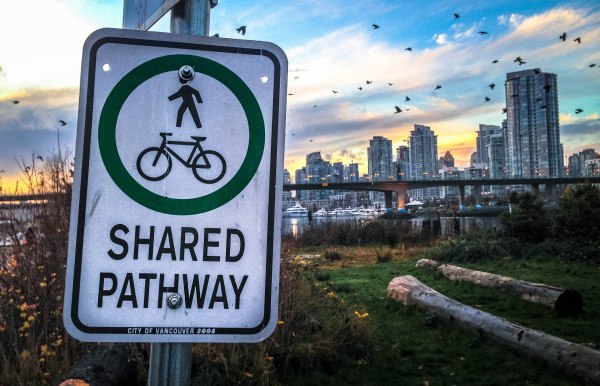
That afternoon, I was riding on a shared pathway and, as usual, was lost in thought. As I neared a pedestrian from behind, I abruptly announced, “On your right.”
“Use your bell,” the woman barked back.
My bell broke last year, and I had forgotten Fred installed a new one.
We met up at the corner where I thanked her. The energy it took to speak up spilled into further admonitions from her and more apologies from me before she paused and complimented me on my bike and asked me where I’d ridden.
Back at home, I caught up on my emails. A friend challenged a suggestion I’d made about the wording of a document our group would use. It became clear what I suggested didn’t line up with our values. Again, I thanked someone for redirecting me.
Three course corrections in one day, and not once was I tempted to scold myself or wonder what was wrong with me. Instead, after a moment of embarrassment, I felt lovingly guided.
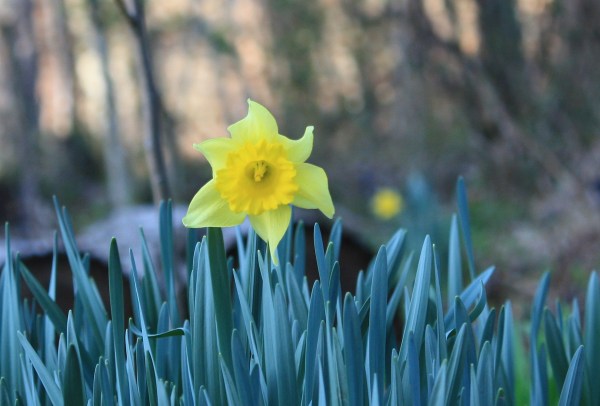
There isn’t just new life in the daffodils peeking out of the ground.
Healthy correction is good, and if you accept it, you will be wise. –Proverbs 15:31 (CEV)
Credits and References: Photo of daffodil by alanmoore55555. Used with permission. Course Corrections by Esther Hizsa, 2025 “Shared Pathway” by Colin Knowles. Used with permission.
I was invited into the desert with You, led there by the Spirit into a barren place with no food.
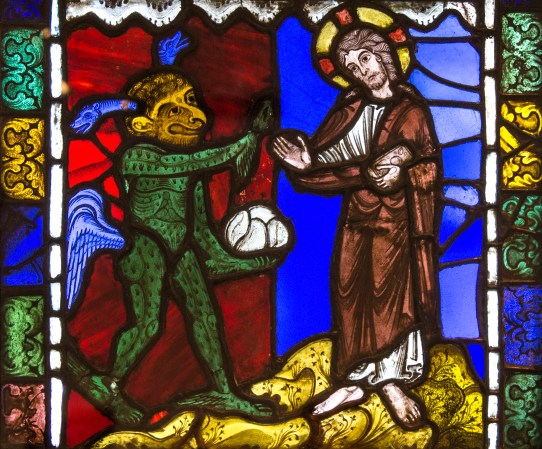
You were tempted to turn stones into bread. You could have done it, but you refused.
If I could have, I would have. Why wait for God to intervene or expect my neighbour to help? It’s the responsible thing to do.
I sat there with You in the wilderness, wondering what it would be like not to offer the solution on the tip of my tongue, not to get up and activate Plan B, but wait a little longer, trust a little more, and let you make the first move.
Rise up, Love! Set me free! For through your guidance… I shall be free to serve Love with a glad and open heart. — Psalm 3:7-8 paraphrased by Nan Merrill, adapted
Credits and References: Stones into Bread by Lawrence OP Detail from a stained window, c.1170-80 in the Victoria & Albert Museum. Creative Commons. Plan A by Esther Hizsa, 2025 Georgia O’Keeffe (1933) by Alfred Stieglitz. Original from The Art Institute of Chicago. Digitally enhanced by rawpixel. Creative Commons.
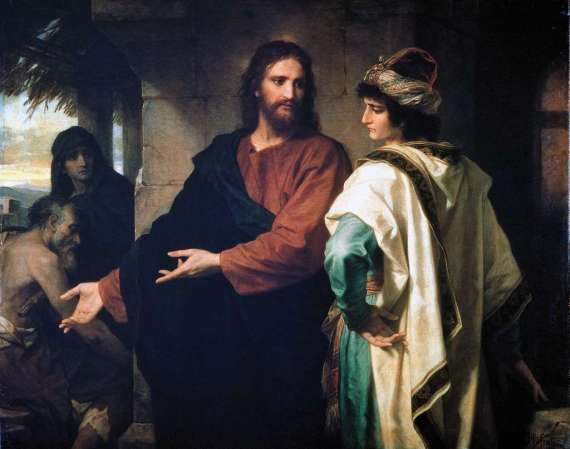
As Jesus started on his way, a man ran up to him and fell on his knees before him. “Good teacher,” he asked, “what must I do to inherit eternal life?” “Why do you call me good?” Jesus answered. “No one is good—except God alone.You know the commandments: ‘You shall not murder, you shall not commit adultery, you shall not steal, you shall not give false testimony, you shall not defraud, honour your father and mother.’” “Teacher,” he declared, “all these I have kept since I was a boy.” Jesus looked at him and loved him. “One thing you lack,” he said. “Go, sell everything you have and give to the poor, and you will have treasure in heaven. Then come, follow me.” At this the man’s face fell. He went away sad, because he had great wealth. –Mark 10:17-27 (NIV)
The first time I was in the place of the rich young man who asked about eternal life, I had no money to give to the poor. I didn’t hear a word Jesus said. All I remember is that he looked at me and loved me, and then my hand was in his.
Whenever I met Jesus in this story afterwards, I asked myself what I was holding onto. I saw the treasures holding me back, but I couldn’t imagine living without them. Jesus said, “Just follow me, anyway.”
This week, when the story came to me again, I noticed the young man didn’t ask to follow Jesus. He asked what he must do to be good– good enough to secure a spot in heaven. Jesus heard the question under his question and gave him what he lacked: He looked at him and loved him.
Then Jesus looked at me lovingly, and I remembered that last week, he tricked me into letting go of a few coins from my treasury. My selfishness was exposed, my goodness in question.
It was a sobering moment. But as I stayed in his heavenly gaze, I realized he wasn’t concerned about my selfishness or how I spend my money but about my preoccupation with what I need to do to prove to myself and others that I’m good.
What if I gave that up for Lent? What if, for the next forty days I took on the spiritual practice of noticing how the desire to be affirmed motivated my actions, ignited my fears, and dominated my thoughts.
I looked back into Jesus’ eyes and listened to my heart and began to imagine a new freedom.
Jesus [on the cross] is trying to make us conscious of the power of divine love to integrate our wounded goodness into himself and then, to move from a preoccupation with sin to a focus on grace. –Louis Savary, The New Spiritual Exercises
Credits and References: Christ And The Rich Young Ruler by Johann Michael Ferdinand Heinrich Hofmann (1824-1911). Creative Commons. What Must I Do to Be Good? by Esther Hizsa, 2025. Christ’s Appearance to the Two Disciples Journeying to Emmaus by John Linnell (16 June 1792 – 20 January 1882). Creative Commons. Photo by Lex McKee. Used with permission.
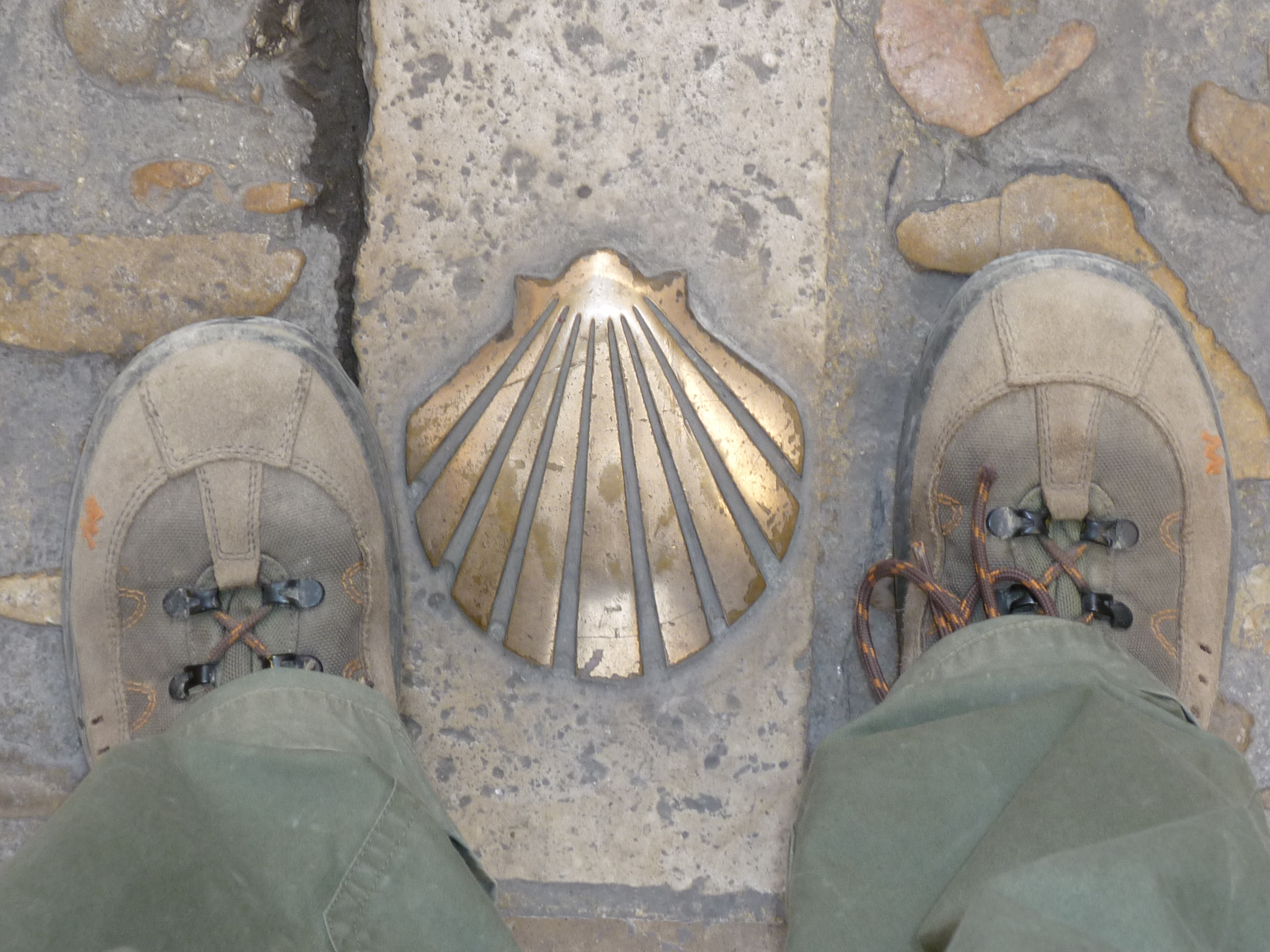
I lace up my shoes and follow
from a safe distance
but it’s bound to happen His eyes will catch mine and I must summon the courage not to look away
for in His loving gaze questions arise memories hopes and fears
and we will carry them all to Jerusalem*
Jesus resolutely set out for Jerusalem. – Luke 9:51
Questions as you begin your Lenten pilgrimage:
What feelings does this poem or these images evoke in you?
What do they tell you about what you are carrying on your Lenten journey?
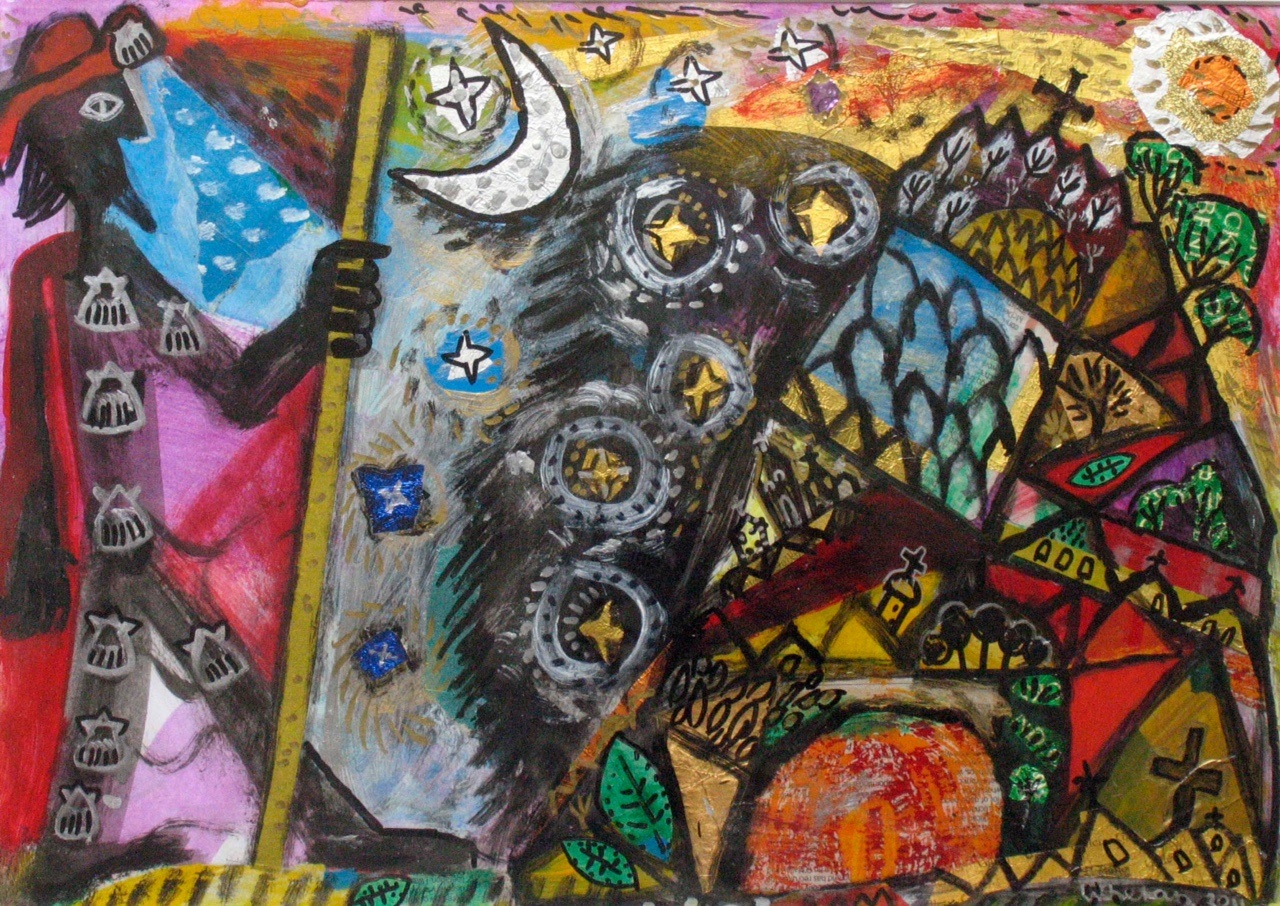
Credits: Photo of hiking boots and scallop shell on the Camino de Santiago de Compostela from Paulo Coehlo forum. Labelled for reuse. “Pilgrimage of Sight” by Brian Whelan was featured in explore, a magazine from the Ignatian Centre of Jesuit Education in Santa Clara California. The painting is owned by the vicar of Blythburgh Church in Suffolk, UK. Used here with permission.
“Pilgrimage” by Esther Hizsa from Stories of an Everyday Pilgrim, 2015.
By the miracle of medicine and grace, my mother woke from the malaise of dementia. For two days, her quick mind was back. She laughed and shared stories. She hugged me and thanked me for taking care of her.
As I held this gift from out of the blue, I could hear my father’s voice clear and kind, how he wished it had been when he was alive. He said, “Everything I did was for Mom and you kids. When I got angry, I was angry at myself.”
What I had wanted to hear my whole life long has always been true. My father loved me. My mother loves me still.
It’s also true that their love was so hidden, so foreign, so unavailable to me, from a very young age that I believed what I feared: I’m not good enough to be loved.
But I don’t have to believe that fear anymore.
The fears that seem to separate me from You shall be transformed and disappear… they shall be gone as in a dream when I Awaken. –Psalm 63:9-11, Nan C. Merrill, Psalms for Praying
Credits and References: Pink flower by Ester Marie Doysabas esterrestrial, CC0, via Wikimedia Commons “Revelation” by Esther Hizsa, 2025. Free parent holding child’s hand image, public domain CC0.
No one can near God unless He has prepared a bed for you. A thousand souls hear His call every second, but most every one then looks into their life’s mirror and says, “I am not worthy to leave this sadness.” –Teresa of Avila
You are worthy to leave this sadness, I hear God say to me in Teresa’s poem.
A cape of sadness slips from my shoulders and falls to the floor. I watch the trapped air dissipate until my sadness is inert.
I think about what makes me sad, who makes me worry, what feels impossible, unfair, losing battles and deep divides. Walk away from all that sadness, you say. You can trust that I will be there no matter what happens.
I try on trust, run my fingers over the smooth burgundy fabric.
I wrap it around me and read the poem again.
You prepare a bed for me . . . a bed in a room, a room in a house. Your house, my home. I live there with you. I have a place at the table. My chair scrapes the floor as I pull it back. I sit down, inch it forward, and see my reflection in my plate. I pick up my fork, my knife, turn it slowly in my hand. There I am again.
I belong. I belong. I belong. I belong. The words chug along like a hundred car train. I watch each car pass. “You belong” is painted on this car, and the next and the next and the next. My head moves back and forth, and back and forth until the words blur into one long ribbon of fact.
I imagine coming home to you, being greeted at the door, sitting on the porch swing, talking about my day. And you tell me every place is home because you are everywhere. Every community is home because you are in each member. I belong to my church, my neighbourhood, my friends, my family, the earth, the sky, and every living thing. I belong here because here is everywhere you call every second.
What do you call out? Come home. You are worthy to leave the sadness of believing you don’t belong.
Imagine living like you belong here. Now step into what you see. Live like you belong here.
It’s time to own your belovedness. –Sarah Kroger, Belovedness
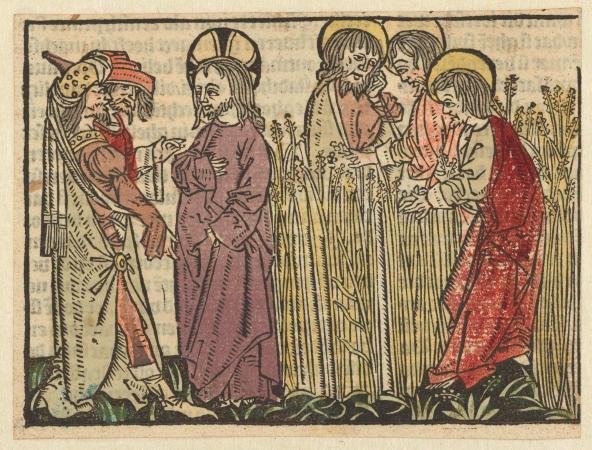
At that time Jesus went through the grain fields on the Sabbath; his disciples were hungry, and they began to pluck heads of grain and to eat. When the Pharisees saw it, they said to him, “Look, your disciples are doing what is not lawful to do on the Sabbath.” He said to them, “Have you not read what David did when he and his companions were hungry? How he entered the house of God, and they ate the bread of the Presence, which it was not lawful for him or his companions to eat, but only for the priests? Or have you not read in the law that on the Sabbath the priests in the temple break the Sabbath and yet are guiltless? I tell you, something greater than the temple is here. But if you had known what this means, ‘I desire mercy and not sacrifice,’ you would not have condemned the guiltless. For the Son of Man is lord of the Sabbath.” –Matthew 13:1-8 (NRSVUE)
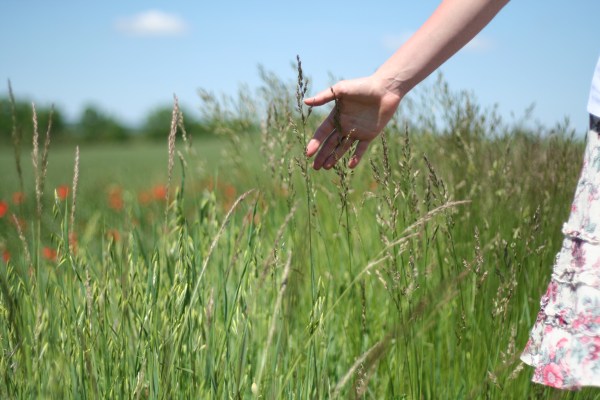
I was hungry, and the wheat was ripe. So, I began picking and eating the chewy grains until I heard,
“What do you think you’re doing?”
My body seized with shame. I clutched the grains tighter, wishing they would vanish like a magician’s trick: when I opened my hands, the evidence would disappear.
I wished I could disappear.
“How can you call yourself a believer and do that?”
The man would have continued, but Jesus stepped between us, casting a cool shadow of safety over me.
“Haven’t you read….?” Jesus said, defending me. “Haven’t you heard…?” Jesus said, supporting me. “If you had known…” Jesus explained. Guilt and shame flew from my body, white doves flapping their wings and taking flight.
Speechless, my accuser went on his way.
Jesus turned to me. Sunlight bathed us in warmth.
“Open your hands,” he said. I did, revealing a few sweaty seeds. He reached out his hands and poured so many plump grains into my cupped hands, I couldn’t hold them all.
I felt the weight in my hands and the weight of what happened.
Then I knew why I was invited into this story, why I experienced it this way.
“You noticed I was bothered by the conversation I had yesterday, didn’t you.”
“Of course,” He said. “You felt judged and accused. You blew it off as nothing, but I didn’t.”
So then, a Sabbath rest still remains for the people of God. –Hebrews 4:9 (NRSVUE)
Credits and References: Disciples plucking grain by Meester van Antwerpen (1485-1491). From Look and Learn, Creative commons . Sabbath Rest by Esther Hizsa, 2025 Hand Through Wild Grass by Lloyd Morgan. Used with permission
Whoever has will be given more; whoever does not have, even what they have will be taken from them. –Mark 4:25 (NIV)
When I heard this scripture one morning, and thought about our generous God, I didn’t hear the word “even.” I heard, “Whoever does not have what they have will be taken from them.”
How is that possible? I wondered. If they have nothing–no sense of God’s love or light– there’s nothing to be taken away. Maybe what they have is blocking love and light? What if that’s what God wants to take away?
Ease washed over me. I knew it was true.
For weeks, I was trapped in the fear of making the wrong decision and being taken advantage of.
Then, after I risked asking all my questions and wearing thin someone’s patience, I completed my research, weighed my options, and made a decision to put my life in their hands.
When I did, I experienced such kindness, I wanted to cry.
Suddenly, my world got bigger. I saw more people in it. I found other questions to ask, other ways of thinking to explore.
I trusted someone, and I saw them do something beautiful with that trust.
I saw that they love to do beautiful things just like I do.
From his fullness we have all received, grace upon grace. –John 1:16 (NRSVUE)