God Sees Me

All of a sudden, I was the boy in the story. I heard Jesus tell the disciples, “You give them something to eat.” While they stood there perplexed, I made my way through the crowd and offered Jesus my uneaten lunch: five small barley loaves and two fish. He received it with such gratitude that I was taken aback. It may not have seemed like much to anyone else but, to Jesus, it was perfect. And then, of course, he did something wonderful with it.

This is what I imagined as I sat in a room filled with people listening to a reflection on the feeding of the five thousand. Tears came to my eyes, I was so moved by my encounter with Jesus.

Jesus had locked eyes with me, received my meagre offering, and cherished it. He saw the childlike desire of my heart to give what I have without stopping to think how insufficient it is.

The next morning, in my prayer time, I return to that encounter with Jesus. I wonder what he received from me. What does my lunch represent?

I picture myself again before him. I offer my attempts to be present, my misfired intentions, my writing. Each gift evokes the telltale signs in my chest and nose that I’m about to cry.

But there’s more. Jesus doesn’t just receive my offerings, he receives me. He looks at me–just as I am–and loves me. Now I have tears in my eyes and a hard lump in my throat.

If there’s one thing I know, that I talk about in sermons, write about on my blog, and hold space for in spiritual direction, it’s this: we are loved just like this.

Once again Jesus steps into my world to tell me what he sees when he looks at me. “If I can look at a goldfish that costs twenty-five cents the way Annie Dillard does, imagine what I see when I look at you.”

And then I hear, “Can you believe that other people see it too? That I couldn’t possibly keep this seeing to myself. How could I? I have to share it with others.”

Now I have tears in earnest and that wonderful witness in my throat. The words that are coming to me are true. “I know how people look at you,” Jesus says. “I know they see what I see. I admit, not everyone and not all the time. But more than you think and more often than you know: you are loved.”

Now I hear music–not choirs of angels in my head but a song my ten-year-old granddaughter listens to. This line keeps echoing, “Can you believe it? Can you receive it?”

Later that morning I walk with a friend who reads my blog. My recent posts have made her sad. She tells me I’m being too hard on myself.

Yup. I think God noticed that too.
Jesus looked at him and loved him. –Mark 10:21 (NIV)


Love Mischief for the World

Mobile Loaves & Fishes is the organization behind Community First! Village in Austin, Texas. “Austin is an awesome place,” says  on Best Tech, “but the way the community is striving to give its homeless citizens a better life is what truly makes it a beautiful city. Community First! Village is a development stretching over 27 acres. It provides affordable, permanent housing for people in Central Texas who are disabled or chronically homeless. Not only does it provide homes, but it also helps these people find jobs and purpose. In 2017, men and women earned $400,000 through the micro-enterprise programs at the Village, so the mission isn’t just to give them places to live but to also help integrate them back into society.”

What love mischief are you and God doing to care for the world?
Let me know and I will include it in an upcoming post.

Credits and References:
Stained glass loaves and fishes in Saint James the Greater Catholic Church, Concord, North Carolina. Photo by Nheyob [CC BY-SA 4.0 (https://creativecommons.org/licenses/by-sa/4.0)], from Wikimedia Commons.
The Feeding of the Five Thousand is in Matthew 14:13-21Mark 6:31-44Luke 9:12-17John 6:1-14
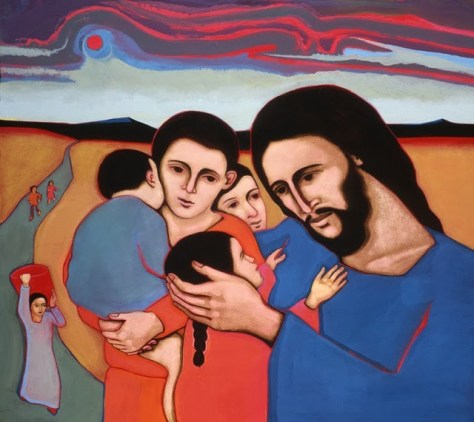
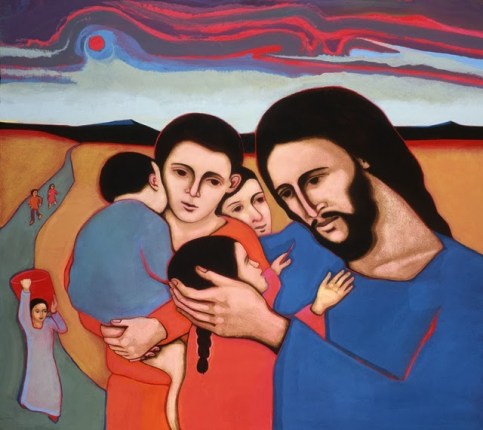
Jesus with the children by Michael O’Brien. Used with permission.
© Esther Hizsa, An Everyday Pilgrim, 2018.
Unauthorized use and/or duplication of this material without permission from Esther Hizsa is strictly prohibited. Excerpts and links may be used provided there is a link to the original content and credit is given as follows:
© Esther Hizsa, An Everyday Pilgrim 2013-2018.  http://www.estherhizsa.com
Posted in Ignatian Spirituality, Mindfulness, Praying with the Imagination, Reflections | Tagged , , , , , , , , , , , | 1 Comment

Seeing Ellery

God, help me see what you see, I pray as I walk.

I wonder if I’ll ever slow down enough to see more than a label: that’s a tree, a flower, a truck that needs a new muffler.

Annie Dillard saw what God saw when she bought a goldfish and named him Ellery.

This Ellery cost me twenty-five cents. He is a deep red-orange, darker than most goldfish. He steers short distances mainly with his slender, red lateral fins; they seem to provide impetus for going backward, up, or down. It took me a few days to discover his ventral fins; they are completely transparent and all but invisible—dream fins. He also has a short anal fin, and a tail that is deeply notched and perfectly transparent at the two tapered tips. He can extend his mouth, so that it looks like length of pipe; he can shift the angle of his eyes in his head so he can look before and behind himself, instead of simply out to his side. His belly, what there is of it, is white ventrally, and a patch of this white extends up his sides–the variegated Ellery. When he opens his gill slits, he shows a thin crescent of silver where the flap overlapped—as though all his brightness were sunburn.

For this creature, as I said, I paid twenty-five cents. I had never bought an animal before. It was very simple; I went to a store in Roanoke called “Wet Pets”; I handed the man a quarter, and he handed me a knotted plastic bag bouncing with water in which a green plant floated and the goldfish swam. This fish, two bits’ worth, has a coiled gut, a spine radiating fine bones, and a brain. Just before I sprinkle his food flakes into his bowl, I rap three times on the bowl’s edge; now he is conditioned, and swims to the surface when I rap. And, he has a heart.

I love how Annie Dillard’s care and observing of Ellery allowed her to see beyond his measurement of usefulness or value.  She enjoyed his beauty and savoured the wonder of this creature that God created, gave life to, and loves.

Rushing from one activity to another forces me to measure, judge, and categorize. With so many things to do, I am often in triage mode, separating whatever comes to me like sheep from goats: useful not useful.

But on the heels of Earth Day, God is inviting me to stop . . . see . . . and fall in love with that tree, that flower–maybe even that truck with the noisy muffler. God knows when I do, I care for the earth and all that is in it the way Annie Dillard cared for Ellery.

God saw all that he had made, and it was very good.
–Genesis 1:31 (NIV)

Love Mischief for the World

Second Nature Home Boutique is a social enterprise entirely focused on eco-friendly, organic products for the home. “A social enterprise is one whose social mission is just as important as their financial mission,” says Elizabeth McKitrick (left),  founder of the store located in East Vancouver. “So it’s on equal footing; you have to make a profit in order to be in business, but the profits are re-invested back into the business for the benefit of all involved [the artisans who make the products, the local community, the environment and the owner].” Elizabeth was interviewed by Maryam Khezrzadeh on Medium.

What love mischief are you and God doing to care for the world?
Let me know and I will include it in an upcoming post.

Credits and References:
Photo of two goldfish by Erin Khoo. Used with permission.
Photo of goldfish by maxxum. Used with permission.
Quote by Annie Dillard in Pilgrim at Tinker Creek
Photo of Elizabeth McKitrick and Elya Bergen at Second Nature Home Boutique by Maryam Khezrzadeh. Used with permission.
© Esther Hizsa, An Everyday Pilgrim, 2018.
Unauthorized use and/or duplication of this material without permission from Esther Hizsa is strictly prohibited. Excerpts and links may be used provided there is a link to the original content and credit is given as follows:
© Esther Hizsa, An Everyday Pilgrim 2013-2018.  http://www.estherhizsa.com
Posted in Creation, Mindfulness, Reflections | Tagged , , , , , , , , , , , , , , , , | 7 Comments

I Love You More than Anything

I love You more than anything.
And when I am in my right mind
I know this to be true 
But You know it all the time.
Rob Des Cotes

If actions speak louder than words, mine wouldn’t say I love God more than anything. They might say it’s true sometimes. Yet God knows–even when I don’t–that it’s true all the time. God isn’t angry when I turn to other loves but stays with me and patiently restores me to my right mind again.

I want to live in my right mind all the time and know what God knows: that I really do love God more than anything. For me, this means waking up to this reality in every moment.

“I think God is inviting me to live mindfully,” I told my spiritual director and waited for her response.

I’ve been seeing my spiritual director for some years now. She will question me if she thinks I am taking on a spiritual practice to earn God’s love or avoid a painful feeling.

She wasn’t questioning me now. Instead, she helped me explore this invitation. As I did, I admitted that being present to whatever I’m doing is often boring.

“I like being entertained and getting a break from the constant chatter in my head,” I said and told her that I enjoy snacking and watching a movie. But I don’t like what it does to my body, how it keeps me up too late and makes me not want to pray.

“What are you thinking?” I asked.

She was reminded of the story of the disciples in the upper room. They had locked the door yet Jesus came in and appeared to them.

My addictions lock me in. But that has not stopped Christ from coming in to free me. He is offering me new life, and this new life is going to take some getting used to.

I told her that I’m clear-headed in the morning, but by evening, I’m at the mercy of my addictions. I mentioned the Ignatian practice of making a plan while in consolation, so I know what to do in times of desolation. I was thinking generally; but she asked me specifically, “What’s  your plan for tonight?”

Yikes. It was a Friday. TGIF. I didn’t want to commit to anything but a pasta dinner and wine with Fred and kicking back. It was hard to make a plan and say out loud that I would pray and go to bed at a decent time. But it was easier to do it with the support of someone who loves me and doesn’t rationalize my addictive behaviours.

As I biked home from that session, I rode mindfully. I counted the revolutions each time my foot pushed down on the pedal. I tried to see how high I would get before I stopped pedalling. To keep counting, I had to pay attention to what I was doing. What a gift to realize that during the hour it took me to get home, I got a break from the chatter in my head.

Even though it felt boring, at nine o’clock I prayed for twenty minutes in silence, read something inspirational, prayed the Examen and the SoulStream Night Prayer, and went to bed. Then I did it the next night and the night after that.

Each morning, I was able to wake an hour earlier than I used to. I had an extra hour to pray and write at the time of day when I’m in my right mind. What a luxury that is.

Ignatius says, “All the things in this world are also created because of God’s love and they become a context of gifts, presented to us so that we can know God more easily and make a return of love more readily.” All things–including Netflix and Scrabble. I still enjoy these gifts, but less often and as a choice instead of a compulsion. And when I do, I enjoy them with God, and it’s the most important thing I do at that moment.

We love because God first loved us.
–1 John 4:19

Love Mischief for the World

Rob Des Cotes founded Imago Dei Christian Communities in 2002.  He became a spiritual director, retreat leader and pastor of Imago DeiHe is the author of four books of meditations for spiritual direction, Fan the Flame, Higher Than I and Ultreia! (Go Higher) and the final book, Strength to Strength. Rob passed away on April 6, 2016, and as it says on the Imago Dei website, he “continued on a new part of the journey with his Father.” Rob was instrumental in making Christian contemplative writings and teachings accessible to all as well as forming community where contemplative practices can be lived out. If you do a search of his name on my blog, you will see some of the ways he has impacted my pilgrimage. He is deeply missed.

What love mischief are you and God doing to care for the world?
Let me know and I will include it in an upcoming post.

Credits and References:
Photo of woman on dock by Matthias Zomer from Pexels. Creative Commons.
Prayer by Rob Des Cotes,  written on October 9, 2014, for Imago Dei Communities.
Ignatius quote from The Spiritual Exercise of Ignatius of Loyola, Principle and Foundation, paraphrased by David L. Fleming.
Jesus with the children by Michael O’Brien. Used with permission.
Photo of Rob Des Cotes used with permission.
© Esther Hizsa, An Everyday Pilgrim, 2018.
Unauthorized use and/or duplication of this material without permission from Esther Hizsa is strictly prohibited. Excerpts and links may be used provided there is a link to the original content and credit is given as follows:
© Esther Hizsa, An Everyday Pilgrim 2013-2018.  http://www.estherhizsa.com
Posted in Easter, Ignatian Spirituality, Overeating, Prayer, Reflections, Rob Des Cotes, Spiritual Direction | Tagged , , , , , , , , , , , , , , , | Leave a comment

Time for Rising

Lift your head and dry your eyes.
Time for rising.
–Steve Bell, Bethany in the Morning

During Lent, I tried unsuccessfully to refrain from zoning out. Many evenings I succumbed to temptation and played Scrabble on my tablet or snacked while watching Netflix. As the weeks passed, I became more and more aware of how my addictions control me.

When I took it to God, I felt invited to renew my practice of Centering Prayer in the morning and do it again in the evening to keep the demons at bay. I hoped this would loosen my addictions’ hold on me and reconnect me to my desire for God.

Sometimes all I could do was make myself sit for twenty minutes in prayer with the promise that I could have a game of Scrabble afterwards. This actually felt like a move forward, and I do think it helped.

Working so hard to pray and fight my addiction doesn’t feel very contemplative. There’s a violent tone to it. Yet Christ didn’t come to me with clubs and swords, but with his breath. Just breathe. That’s all I had to do.

On Easter weekend, I listened to a podcast by Christine Valters Paintner on work. She quoted Thích Nhất Hạnh and in a guided meditation invited me to pay attention to what happens in my body when I rush and what happens when I’m present.

As I said last week, that’s when Christ appeared to me. Now was the time for rising.

I began reading Thích Nhất Hạnh’s The Miracle of Mindfulness and Richard Rohr’s The Naked Now and committed myself to a few simple practices:

  • Practice Centering Prayer 20 min twice a day.
  • Pray the Examen at the end of the day.
  • Whenever your mind is dispersed, pay attention to your breath. Count it. Let it return you to the present.
  • As much as possible, wherever you are, be fully there. Let it be the most important thing to do.

I get nervous when I write a “To Do” list like this. I don’t want to set myself up for failure. But in another podcast, Paintner talked about her rule for Sabbath keeping and admitted that, although she cannot always keep it, it’s good to return to. She likened it to what happens in Centering Prayer: when our mind wanders off, we are invited to gently return to God.

This felt doable.

An Ignatian practice is to recognize times of consolation (when we are turned toward God) and times of desolation (when we are turned away). Then make a plan while in consolation for what to do when desolation comes.

Mornings are my times of consolation and evenings are my dark times. By committing to these practices in the morning, even if I can’t always do them, there’s more possibility that I will.

I may not be able to sit for long or pray the Examen, but I can follow my breath for a few minutes and be aware of God praying in me, loving me, now, and now, and now.

The one thing we do every moment of our lives [i.e. breathe] is therefore to speak the name of God. This makes it our first and last word as we enter and leave this world.–Richard Rohr, The Naked Now: Learning to See as the Mystics See

On the evening of that first day of the week, when the disciples were together, with the doors locked for fear of the Jewish leaders, Jesus came and stood among them and said, “Peace be with you!” After he said this, he showed them his hands and side. The disciples were overjoyed when they saw the Lord.

Again Jesus said, “Peace be with you! As the Father has sent me, I am sending you.” And with that he breathed on them and said, “Receive the Holy Spirit.” –John 20:19-22 (NIV)

 * * *

Love Mischief for the World

Christine Valters Paintner , PhD, OblSB, REACE is the online Abbess of Abbey of the Arts, a Benedictine oblate, and the author of 8 books on monastic spirituality and creativity, as well as a poet, photographer, spiritual director, pilgrim guide, and teacher. I met Christine at a workshop SoulStream hosted for spiritual directors a few years ago. I still have the collage I made that day. This Easter, I signed up for Christine’s “daily nourishment” and received an invitation to take a free 8-day “Monk in the World” e-course, which contains the podcasts I referred to in my post today. I found her course so helpful, I have recommended it to directees and friends. The podcast I listened to on work is on the fifth day of that course. 

What love mischief are you and God doing to care for the world?
Let me know and I will include it in an upcoming post.

Credits and References:
Raising of Lazarus photo by Ted. Used with permission. This brightly-coloured icon is a fresco on the wall in the Monastery of St. John near Athens.
Richard Rohr, The Naked Now: Learning to See as the Mystics See, page 25.
Sunrise by Susanne Nilsson . Used with permission.
Photo of Christine Valters Paintner used with permission.
© Esther Hizsa, An Everyday Pilgrim, 2018.
Unauthorized use and/or duplication of this material without permission from Esther Hizsa is strictly prohibited. Excerpts and links may be used provided there is a link to the original content and credit is given as follows:
© Esther Hizsa, An Everyday Pilgrim 2013-2018.  http://www.estherhizsa.com
Posted in Easter, Ignatian Spirituality, Mindfulness, Overeating, Reflections | Tagged , , , , , , , , , , , , , , , , , , , | Leave a comment

Miracle Moments

I love the drama in the stories of Jesus’ resurrection, watching the progression from sadness and despair to confusion and then to joy. One minute life is dark and pointless and the next, it’s bright and full of possibility. Jesus’ presence changes everything.

I’ve experienced this myself and seen it in others as we bring our troubles into the light. There, in Christ’s presence, the very thing we’re afraid of loses its power, and trust rises. It’s a miracle moment.

Speaking of miracles, my Christmas cactus is in full bloom for the fourth time since before Advent. It seems Christ wants to bring new life everywhere, in everything.

I came across this quote:

If while washing dishes, we think only of the cup of tea that awaits us, thus hurrying to get the dishes out of the way as if they were a nuisance, then we are not “washing the dishes to wash the dishes.” What’s more, we are not alive during the time we are washing the dishes. In fact, we are completely incapable of realizing the miracle of life while standing at the sink. If we can’t wash the dishes, the chances are we won’t be able to drink our tea either. While drinking the cup of tea, we will only be thinking of other things, barely aware of the cup in our hands. Thus we are sucked away into the future–and we are incapable of actually living one minute of life. ―Thích Nhất Hạnh, The Miracle of Mindfulness

After I read this, I noticed times when I’m not alive. I often rush through one activity to get to another. I also noticed, just as Thích Nhất Hạnh says, that when I finally get to do what I wanted to, it’s not as satisfying as I’d hoped.

When Christ appeared to me in this quote, I  wasn’t sad or desperate. I was feeling flat and bored, looking for the next best thing to entertain me. My Lord showed me there’s no life in that tomb. The miracle is right here, right now, in this moment.

Thích Nhất Hạnh writes,

. . . the real miracle is not to walk on water or in thin air, but to walk on earth. Every day we are engaged in a miracle which we don’t even recognize: a blue sky, white clouds, green leaves, the black, curious eyes of a child–our own two eyes. All is a miracle.

Hmm. This is going to take some practice.

Jesus answered him, “Very truly, I tell you, no one can see the kingdom
of God without being born from above.” –
-John 3:3 (NIV)

Love Mischief for the World

Thích Nhất Hạnh, born in 1926, is a Vietnamese  Buddhist monk and peace activist. He lives in the Plum Village meditation center in southwest France,  travelling internationally to give retreats and talks. After a long-term of exile, he was given permission to make his first return trip to Vietnam in 2005. Nhất Hạnh has published more than 100 books, including more than 40 in English. He is active in the peace movement, promoting nonviolent solutions to conflict. His book, The Miracle of Mindfulness, teaches people of any religion how to be consciously alive to every moment. (Wikipedia)

What love mischief are you and God doing to care for the world?
Let me know and I will include it in an upcoming post.
Credits and References:
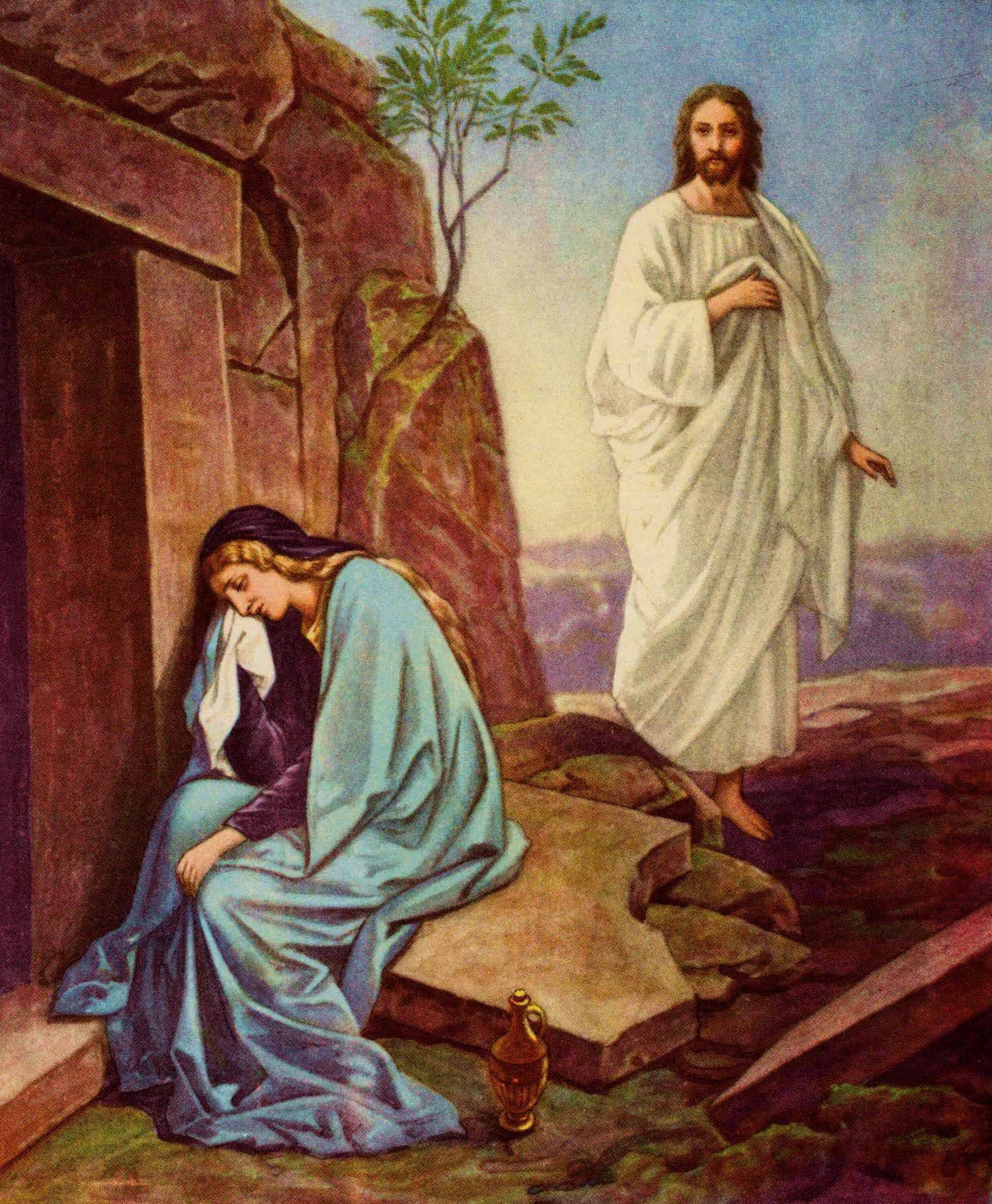
Christ appears to Mary Heinrich Hofmann, published on Bible card [Public domain], via Wikimedia Commons
Photo of boy on path from Pixabay. Creative Commons.
Photo of Thích Nhất Hạnh by Duc (pixiduc) from Paris, France. (Thich Nhat Hanh Marche meditative 06) [CC BY-SA 2.0 (https://creativecommons.org/licenses/by-sa/2.0)%5D, via Wikimedia Commons
© Esther Hizsa, An Everyday Pilgrim, 2018.
Unauthorized use and/or duplication of this material without permission from Esther Hizsa is strictly prohibited. Excerpts and links may be used provided there is a link to the original content and credit is given as follows:
© Esther Hizsa, An Everyday Pilgrim 2013-2018.  http://www.estherhizsa.com
Posted in Easter, Mindfulness, Reflections | Tagged , , , , , | 4 Comments

Purple Everywhere

John and Peter rush to the tomb.

If it’s empty, as she said,
then–

Prayers rise to their lips
leap from their hands.

God runs to meet them,
spilling purple
everywhere.


Credits and References:
Painting of the disciples Peter and John running to the tomb on the morning of the resurrection by Eugène Burnand (1850-1921) [Public domain], via Wikimedia Commons
© Esther Hizsa, An Everyday Pilgrim, 2018.
Unauthorized use and/or duplication of this material without permission from Esther Hizsa is strictly prohibited. Excerpts and links may be used provided there is a link to the original content and credit is given as follows:
© Esther Hizsa, An Everyday Pilgrim 2013-2018.  http://www.estherhizsa.com
Posted in Easter, Poetry, Reflections | Tagged , , , , , | Leave a comment

Writing a Prayer

My friend
wrote
this icon.

“You don’t paint icons,”
she said.
“You write them.
You are writing
a prayer.

“You begin with a small
brush. Then use
smaller and
smaller
ones.”

She entered the tomb
with her
brushes,
paint and
trepidation.

She paced
and wrote
until her prayer
appeared–
white linen, dark robe,
beard, fingers, forehead,
her lips and his,
her cheek on his,
his life for hers.


Credits and References:
Partial copy from The Entombment (Russian, Late 15th Century) Icon written and photographed by Ann Green. Used with permission.
© Esther Hizsa, An Everyday Pilgrim, 2018.
Unauthorized use and/or duplication of this material without permission from Esther Hizsa is strictly prohibited. Excerpts and links may be used provided there is a link to the original content and credit is given as follows:
© Esther Hizsa, An Everyday Pilgrim 2013-2018.  http://www.estherhizsa.com
Posted in Easter, Holy Week, Poetry, Reflections | Tagged , , , , , , , | 2 Comments

Our Hands Have Touched God

That which was from the beginning, which we have heard, which we have seen with our eyes, which we have looked at and our hands have touched—this we proclaim concerning the Word of life. —1 John 1:1

On this day,
my prayer takes me
to the cross.

I hear
God’s laboured breath
and final words.

I see
God’s arms outstretched and aching,
hands pierced,
head crowned,
face in agony.

I touch
God’s bleeding feet.
My fingers tell Emmanuel,
“I’m here.”

My mind wants to
run and hide
in theology or memories,
but my gut is curt:
Stay here.

I kiss
God’s feet and bless
my lips and fingers.


Credits and References:
“Christ on the Cross” by Sonnenstrahl on Pixabay. Creative Commons.
© Esther Hizsa, An Everyday Pilgrim, 2018.
Unauthorized use and/or duplication of this material without permission from Esther Hizsa is strictly prohibited. Excerpts and links may be used provided there is a link to the original content and credit is given as follows:
© Esther Hizsa, An Everyday Pilgrim 2013-2018.  http://www.estherhizsa.com
Posted in Easter, Holy Week, Poetry, Reflections | Tagged , , , , , , , | 1 Comment

Jesus Shows the Full Extent of His Love

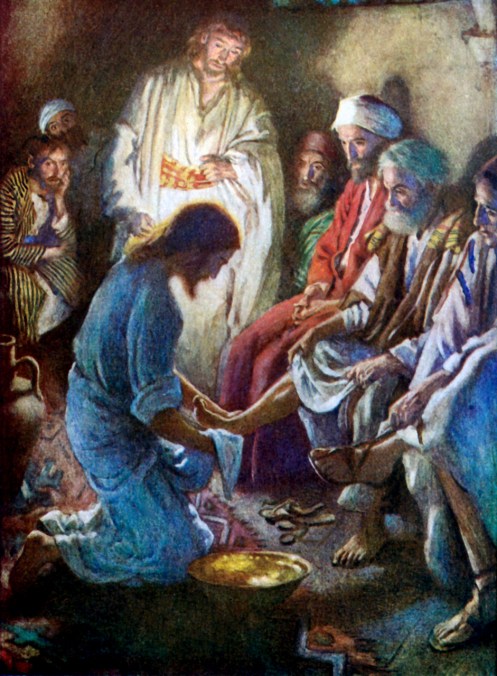
It was just before the Passover Feast. Jesus knew that the time had come for him to leave this world and go to the Father. Having loved his own who were in the world, he now showed them the full extent of his love. . . so he got up from the meal, took off his outer clothing and wrapped a towel around his waist. After that, he poured water into a basin and began to wash his disciples’ feet, drying them with the towel that was wrapped around him. –John 13:1, 4,5 (NIV)

Jesus got up, took a basin of water and washed the disciples’ feet. The Son of God expressed the full extent of his love by caring for their bodies. He loved them entirely heart, soul, and body.

What might Jesus feel as he washed his beloved friends’ feet?

Perhaps a shudder of fear as he touched the place where his own feet would be pierced. Perhaps a wave of gratefulness that, for now anyway, their feet would be spared. Perhaps an ache of loss, knowing they’ve reached their destination. Perhaps a rising of hope as he imagines walking with them again.

What do I feel as Jesus washes my feet?

Embarrassed that he would care more for my feet than I do. A little overwhelmed at the intimacy of his touch. I struggle to stay present and be loved in this wordless way. I want it to be done and for him to never stop all at the same time. I fear I will be forgotten when he goes on to the others, yet I see them and want them to enjoy his extravagant love too.

What does my body feel?

Jesus’ holds my foot with one hand and pours warm water over it with the other. Then lowers my foot into the basin and washes between my toes. My skin feels the gentle touch of his hands, the warmth of the water, the coolness of the air as each foot is lifted and dried. I feel the tingle of clean, the invitation to rest, and the desire to keep following my Saviour.

* * *

Reflection questions for Maundy Thursday:

  • Imagine Jesus washing your feet. What goes on for you?
  • What feelings arise?
  • What conversation is sparked?
Credits and References:
Jesus washes the disciples’ feet by Harold Copping (1863-1932) from Waiting For The Word
 © Esther Hizsa, An Everyday Pilgrim, 2018.
Unauthorized use and/or duplication of this material without permission from Esther Hizsa is strictly prohibited. Excerpts and links may be used provided there is a link to the original content and credit is given as follows:
© Esther Hizsa, An Everyday Pilgrim 2013-2018.  http://www.estherhizsa.com
Posted in Easter, Holy Week, Praying with the Imagination, Reflections | Tagged , , , , , , , , , , | 2 Comments

Your King Is Coming

Do not be afraid, Daughter Zion;
    see, your king is coming,
    seated on a donkey’s colt. 
–John 12:15

Savour these words with me.

Do not be afraid, Daughter Zion; see, your king is coming. . .

Ever since I was young, waiting for someone to arrive makes me anxious. Fear asks, What if they don’t come? What if you don’t really matter? But in these words of John, reality tugs at my sleeve. “Look. See for yourself. Your king is coming. There he is, seated on a donkey.”

Daughter Zion. . .

Ever since I was young, I’ve had trouble believing I’m lovable. I was rarely anyone’s first choice. If I was, I assumed there must be something wrong with the person who would choose me. Whenever I started to believe I was good enough to be loved, something would happen to prove that I wasn’t. But the Christ who rides into Jerusalem every Palm Sunday comes and shows me the people in my life who know me and love me the way God does–just as I am. I am invited to lay down my palm branch and believe I am a beloved daughter and friend.

Your king is coming, seated on a donkey’s colt.

Ever since I was young and got in trouble for being bad, I was afraid of God. I knew Jesus loved me because the Bible told me so, but God, who knows all and sees all, I wasn’t so sure about. But Jesus shows us that God is like him: gentle, benevolent, and more loving than the most loving person you know.

“Recall a time when you felt loved or felt love for another,” Matthew Linn, SJ said when he came to Vancouver recently. “God loves you even more than that. Rest in this image as you go to sleep at night. Recall it again when you wake up in the morning.” This is our king. This is our God.

Gaylon Keeling Contemplation...Keeping Watch by Hafiz

In the morning
When I began to wake,
It happened again–

That feeling
That You, Beloved,
Had stood over me all night
Keeping watch,

That feeling
That as soon as I began to stir
You put Your lips on my forehead
And lit a Holy Lamp
Inside my Heart.

 * * *

For reflection and prayer:

  • What else do you hear in this verse?
  • What fear in you is being allayed?
  • Imagine laying down a palm branch and welcoming all the love you long for.
  • Steve Bell’s song “Lenten Lands” (lyrics by Malcolm Guite) echoes today’s theme. You may want to have a listen.
Credits and References:
“Entry into Jerusalem” by Giotto di Bondone (c. 1267 – January 8, 1337). Creative Commons.
“Contemplation” by Gaylon Keeling. Used with permission.
“Keeping Watch” is in I Heard God Laughing: Poems of Hope and Joy by Hafiz (Author), Daniel Ladinsky (Translator). Used with permission.
© Esther Hizsa, An Everyday Pilgrim, 2018.
Unauthorized use and/or duplication of this material without permission from Esther Hizsa is strictly prohibited. Excerpts and links may be used provided there is a link to the original content and credit is given as follows:
© Esther Hizsa, An Everyday Pilgrim 2013-2018.  http://www.estherhizsa.com
Posted in Holy Week, Lent, Reflections | Tagged , , , , , , , , , | Leave a comment