The Other Voice in My Head

Wrong Way by Crystal

I’m doing it wrong.

The voice in my head didn’t mince words. What “it” referred to wasn’t something innocuous like following a recipe; it was my whole spiritual life.

Sometimes I’m so confident. I write confidently; I live confidently. Other times I have no idea what I am doing or why or if it really matters.

This voice in my head isn’t solely mine: it’s a collection of every voice I have ever heard, human or divine. Thankfully this composite voice is not the only one in my head. God, pure and loving, lives there too.

Slowing down enabled me to hear this destabilizing judgment. At first, it made me want to give up altogether. But as I sat with it, I heard the voice of Love. That voice said, “Hmm. You know, that wasn’t Me who said that.”

God brought to mind a dear friend who appears to be doing life all wrong (and people constantly remind him of it). I imagined God seeing him and celebrating the successes others don’t see. I know God is proud of him.

And what about me, God? Are you proud of me?

Hafiz, a fourteenth century Persian poet, once wrote, “I am a hole in a flute that Christ’s breath moves through—listen to this music.”

And this is what Hafiz played me:

It used to be
that when I would wake in the morning
I could with confidence say,
“What am ‘I’ going to
do?”
That was before the seed
cracked open.
Now Hafiz is certain:
There are two of us housed
in this body,
doing the shopping together in the market and
tickling each other
while fixing the evening’s food.
Now when I awake
all the internal instruments play the same music:
“God, what love-mischief can ‘We’ do
for the world
today?”

Confident or not, right or wrong, up or down, it doesn’t matter. Whatever I’m doing, I’m not doing it alone. There are two of us housed in this body, and as longs as One of us knows how to love, the world will be blessed.

Steveston 048copy

 “For my thoughts are not your thoughts,
    neither are your ways my ways,”
declares the Lord. — Isaiah 55:8
Credits and references:
“Wrong Way” by Crystal. Used with permission.
“Seed Cracked Open” by Hafiz in The Gift by Hafiz (Author), Daniel Ladinsky (Translator). Used with permission.
“Splash!” by Anne Yungwirth. Used with permission.
© Esther Hizsa, An Everyday Pilgrim, 2015.
Unauthorized use and/or duplication of this material without permission from Esther Hizsa is strictly prohibited. Excerpts and links may be used provided there is a link to the original content and credit is given as follows: © Esther Hizsa, An Everyday Pilgrim 2013, 2014, 2015.  http://www.estherhizsa.wordpress.com.
Posted in Poetry, Popular Posts, Poverty of Spirit, Stories | Tagged , , , , , , , , , | 239 Comments

Life in the Slow Lane

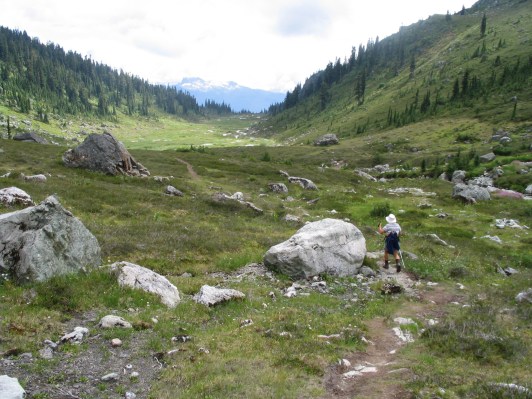
Down from Mt Brandywine

After eight slow days on the “mountain” with God, I wanted to maintain a more leisurely pace back in the valley of the shadow of life.

I took a hard look at my calendar and wondered how I was going to do everything without rushing. In addition to my usual work, I had promised to help my friend move. He had been homeless for a while and now finally found a place nearby. He didn’t have much; I could fit most of what he had temporarily stored at the church into my car. So I thought this would be a half-hour job.

The operative word here is “most.” What didn’t fit in had to be attached to a bike trailer that he built while I waited. The man’s an absolute genius with what he can construct with a set of tools and stuff destined for the dump. But it ended up taking four hours and there was nothing I could do but watch and wait.

Yet I sensed God knew that. God was fully aware of all I needed to do and–with divine wisdom–had decided I could afford to spend the afternoon this way. So I relaxed a little and went with the flow. The next day our contemplative group reflected on God’s expansive love.

What came to me in the silence was that I had joined God in loving our friend, and that meant a lot to both of them. I didn’t feel it at the time I was helping him; I had felt bored and impatient. But afterwards, when I saw the smile on my friend’s face, I felt good.

“Slow down,” God says when I am tempted to rush. “Trust me. Everything will get done on time.”

So I’m trying to engage my slow-twitch muscles. I’m taking time to listen longer to others and to myself while I bike places instead of driving. I’ve noticed that I begrudge the time it takes to prepare a meal or tidy my things. Perhaps I could learn to enjoy these activities instead.

Meanwhile, God, like a crossing guard, holds back the traffic of my life with one hand, halts the oncoming world with the other, and says, “Don’t rush her. She’s doing important work here.”

A Snail's Pace by Ken Slade

Let me serve love with my strength this day,
let me serve love with my strength.
In heart and mind and body this day
let me serve love.
— J. Philip Newell

Credits and References: “Coming down from Brandywine Mountain, B.C.” by Fred Hizsa. Used with permission. “A Snail’s Pace” by Ken Slade. used with permission. We were reflecting on Ephesians 3:14-21. Sounds of the Eternal: A Celtic Psalter by J. Philip Newell (Tuesday morning prayers)
© Esther Hizsa, An Everyday Pilgrim, 2015. Unauthorized use and/or duplication of this material without permission from Esther Hizsa is strictly prohibited. Excerpts and links may be used provided there is a link to the original content and credit is given as follows: © Esther Hizsa, An Everyday Pilgrim 2013, 2014, 2015.  http://www.estherhizsa.wordpress.com
Posted in Ignatian Spirituality, Poverty of Spirit, Stories, Wednesday Lunch Club | Tagged , , , , , , , , | 3 Comments

When We Don’t Receive the Grace We Asked for

I've got nothing Garrett Charles

One more thing I want to share with you about my eight-day retreat. Following Ignatius’s example, Sylvester, my spiritual director for the week, encouraged me to ask God for the particular grace I wanted to receive from God in each prayer. For example, in one prayer I asked for the grace to have a felt knowledge of God’s love for me. In another, Sylvester suggested I ask the Holy Spirit to reveal to me what I received from my childhood.

Sometimes I received the grace I asked for, but other times I didn’t. When I talked with Sylvester about it, he wasn’t perturbed in the least. “If we don’t receive the grace we ask for, that’s all right. We can trust that God will give us what we need in due course,” he said. “However, if we feel responsible for receiving any grace, this will lead us away from God into desolation.”

That reminded me of something Sylvester explained earlier in the week. He talked about Jesus being “Lord.” He said, “That word is out of fashion these days, because we don’t have lords or subjects any more. But in Jesus’s day they did. Subjects did whatever their lord wanted and lords, knowing their subjects were completely dependent on them, took care of their every need.”

It’s hard to imagine this system working well because many lords abused their power and neglected their responsibility. But what about Lord Jesus? Now he is a lord that takes his role seriously. So much so, that he laid down his life for his subjects. Night and day he attends to every detail of our lives and does whatever it takes to enable us to receive and give love. Sometimes “whatever it takes” includes not answering our prayers the way we would like him to.

Ignatius believed that “all the things in this world are gifts of God, presented to us so that we can know God more easily and make a return of love more readily.”

“But what if I’m doing something wrong when I pray that is blocking God from giving me the wisdom or strength that I need?” I asked.

Once again Sylvester smiled at me lovingly. “You worry about God, and God will worry about you.”

That meant I don’t have to fix myself or try to be more than I am, even if being “more” would make life so much easier. All I need to do is receive what my Lord gives. Good Lord, what a concept!

Hand through Wild Grass by Lloyd Morgan

See how the flowers of the field grow. They do not labour or spin. Yet I tell
you that not even Solomon in all his splendour was dressed like one of these.

If that is how God clothes the grass of the field, which is here today and
tomorrow is thrown into the fire, will he not much more clothe you—you of
little faith?
Therefore I tell you, do not worry about your life… 
But seek first
his kingdom and his righteousness, and all these things will be given to you
as well.” — Matthew 6:25-33 (NIV)


Credits and references:
“I’ve Got Nothing” by Garrett Charles. Used with permission.
An excerpt from Principal and Foundation of the Ignatian Spiritual Exercises,  paraphrased by David L. Fleming.
“Hand in Wild Grass” by Lloyd Morgan. Used with permission.
© Esther Hizsa, An Everyday Pilgrim, 2015.
Unauthorized use and/or duplication of this material without permission from Esther Hizsa is strictly prohibited. Excerpts and links may be used provided there is a link to the original content and credit is given as follows: © Esther Hizsa, An Everyday Pilgrim 2013, 2014, 2015.  http://www.estherhizsa.wordpress.com


Posted in Ignatian Spirituality, Prayer | Tagged , , , , , , , , , , , | 2 Comments

Waiting for the Other Shoe to Drop

leaves by Paul

I can’t spend a whole week on retreat with a holy God and not be confronted with my sins, I thought. Yet every time Sylvester assigned scriptures for me to pray with, it never came up. I started to believe I was going to avoid the painful subject altogether.

However, I did notice that God brought a number of things to my awareness. I saw ways in which I looked at others or myself that could be framed in a different light. For example, instead of comparing myself to someone and feeling inadequate, I could be thankful that God gave them the grace to do what was needed. It wasn’t until much later that I realized I had been judgemental.

Blemish by Dave Shafer

God’s gentleness reminded me of a quote by Julian of Norwich, who lived in the fourteenth century. She said.  “The mark of sovereign friendship of our courteous Lord is that he keeps us so tenderly while we are in sin; and furthermore he touches us so secretly and shows us our sin by the sweet light of mercy and grace.”

In one of my prayer periods, I watched a “sinful” woman wash Jesus’s feet with her tears and anoint them with perfume and saw his grateful response. In another, Jesus washed my feet just as tenderly. First he wept over all my suffering, taking every hurtful slight and painful action I had experienced onto himself. Then he kissed my feet, absorbing all the suffering I have caused others.

Although foot washing was a lowly job, Jesus didn’t begrudge doing it or scold me for getting my feet dirty. He wanted to do it. It was his way of showing me the full extent of his love.

Jesus knew that the time had come for him to leave this world and go to the Father. Having loved his own who were in the world, he now showed them the full extent of his love.  — John 13:1 (NIV, 1978)

Credits and references:
“Autumn Leaves 2” by Paul. used with permission.
“Blemish” by Dave Shafer. Used with permission.
© Esther Hizsa, An Everyday Pilgrim, 2015.
Unauthorized use and/or duplication of this material without permission from Esther Hizsa is strictly prohibited. Excerpts and links may be used provided there is a link to the original content and credit is given as follows: © Esther Hizsa, An Everyday Pilgrim 2013, 2014, 2015.  http://www.estherhizsa.wordpress.com
Posted in Ignatian Spirituality, Poverty of Spirit, Prayer | Tagged , , , , , , , , , | 2 Comments

My Soul Speaks

Christ and the Samaritan womanJesus kept his promise. During my eight-day retreat, he showed himself to me as I prayed with biblical stories and imagined myself as Hannah, the woman by the well, a child playing with Jesus, and the apostle Peter.

“When you pray, ask for the grace to receive an interior knowledge of God’s faithfulness and care for you,” Sylvester, the spiritual director, suggested at one of our daily meetings.

Pride nudged me. “You mean a deeper knowledge than I already have,” I said.

He smiled. “Each time we are given a grace, it’s a new gift.”

The story of Hannah and how God answered her prayer to bear a child reminded me of times in my life when God used adversity to bring forth life. I felt grateful that God remembered me like he did her.

But in my prayers, the Spirit didn’t just want to remind me of things, the Spirit wanted to listen. Being assured of God’s faithfulness and care enabled my soul to speak frankly.

When the woman at the well saw Jesus as just one more person without a bucket who wanted something from her, I realized I felt that way sometimes too. In another prayer, I pictured Jesus with the children and was invited to be one of them. I sobbed, “I don’t want to be a child. It’s not safe; adults can’t be trusted.” Later in the week, I shared Peter’s anguish that, despite my best intentions, I hadn’t kept my promises to God.

As each thought was voiced, the Spirit seemed to say, “I know. I know.”

The Trinity tenderly responded to my confessions of prejudice, fear and failure as each story unfolded in my imagination. At the well, Jesus revealed himself to me as the Messiah and gave me living water. When I asked him where I would find this water, he showed me the seemingly bucketless people in my life. Despite appearances, they have much to offer me. Living water flows in them, and I was encouraged to drink deeply.

Jesus with childrenAfter I watched Jesus with the children, the Trinity crouched down and made the frightened child in me an offer: What if we adopt you? Then I saw God in the faces of women who have loved me like a mother, and men who have cared for me like a father.

And when the rooster crowed, Jesus looked right at me and loved me the same way he always does: without a shred of disappointment in his eyes. These moments were new gifts indeed. They blessed my soul and set it free.

Jesus said, “I will not leave you as orphans; I will come to you.” —John 14:18

Credits and References:
Christ and the Woman of Samaria II by Guercino (Giovanni Francesco Barbieri), 1591–1666
Jesus with Children, artist unknown.
1 Samuel 1; John 4; 1-26; Matthew 18:1-5; Luke 22:54-62
© Esther Hizsa, An Everyday Pilgrim, 2015.
Unauthorized use and/or duplication of this material without permission from Esther Hizsa is strictly prohibited. Excerpts and links may be used provided there is a link to the original content and credit is given as follows: © Esther Hizsa, An Everyday Pilgrim 2013, 2014, 2015.  http://www.estherhizsa.wordpress.com
Posted in Ignatian Spirituality, Prayer, Praying with the Imagination | Tagged , , , , , , , , , , , , | 8 Comments

Eight Days Alone with God

Silent Prayer by Neil GallopAfter a long kiss goodbye, Fred drove off.  I brushed off my nervousness and unpacked my things. It didn’t take long–just clothes, knitting needles and yarn, my Bible, notebook and a copy of the Ignatian Spiritual Exercises. No computer, no other books, no phone.  For the next week, even though I was with friends at the retreat centre, the only person I would talk to was God and my spiritual director, a young Jesuit named Sylvester.

At our first meeting, Sylvester asked me to tell him a bit about my life. Then he suggested a few passages of scripture to begin praying with. He said, “Spend an hour praying with the passage. Don’t study it; imagine yourself in it. Allow yourself to enter into a conversation the Trinity is having about you.”

十字架 CrossThat evening, I went into the chapel to pray. I could still smell the incense from Vespers. After that service, Sylvester had turned the crucifix and large Bible on the altar to face the Blessed Sacrament. Then he genuflected.

I bowed my head and prayed, as Ignatius directed, asking for the grace that all my “intentions, actions and operations be directed purely to the service and praise of His Divine Majesty.” My heart beat with longing that it be so.

I turned to John 14 and was drawn by Jesus’s statement, “I am in my Father, and you are in me, and I am in you.” I pictured myself completely immersed in love. It felt spacious, safe and peaceful.

Further on in the passage, Jesus said five times that, after he died, he would come back and show himself to them. Was Jesus promising to show himself to me too?

The next morning, I sat on my bed and prayed, cradling a cup of hot tea. In Isaiah, the Trinity exuberantly invited me to come and satisfy my soul with rich food. God’s word would not return empty; God promised, “I will accomplish what I desire.”

What did the Trinity desire for me?

Sylvester told us that morning in a short lecture, “God is love and love requires a recipient. You can’t just love. You have to love something or someone. God is love because God is Three Persons–Father, Son and Holy Spirit–loving each other. And God created us to share their love.”

I felt a flutter in my chest. God’s great desire–more than anything else–was that I be shown that love for eight days straight.

Redemption by Miwok

As the rain and the snow
    come down from heaven,
and do not return to it
    without watering the earth
and making it bud and flourish,
    so that it yields seed for the sower and bread for the eater,
 so is my word that goes out from my mouth:
    It will not return to me empty,
but will accomplish what I desire
    and achieve the purpose for which I sent it. — Isaiah 55:10-11

Credits and references:
“Silent Prayer” by Neil Gallop.
“Cross” by Dennis Wong. used with permission.
“Redemption” by Miwok. Used with permission.
The Spiritual Exercises of St.Ignatius of Loyola (1419-1556), annotation 46.
John 14:20; Isaiah 55:2,11
© Esther Hizsa, An Everyday Pilgrim, 2015.
Unauthorized use and/or duplication of this material without permission from Esther Hizsa is strictly prohibited. Excerpts and links may be used provided there is a link to the original content and credit is given as follows: © Esther Hizsa, An Everyday Pilgrim 2013, 2014, 2015.  http://www.estherhizsa.wordpress.com
Posted in Ignatian Spirituality, Prayer | Tagged , , , , , , , , , , , , , , , , | 7 Comments

As Good as It Gets

I don’t get to enjoy my spiritual growth spurt for long before I’m made aware of more shortcomings. And not imaginary ones either. I’m talking significant habits that drive people up the wall. My first reaction is to cocoon, my second is to draw up a plan to fix myself. Thankfully wisdom intervenes, and I finally sit with God in my disappointment and sadness.

And what does God do? God doesn’t protect me from reality, nor is God intent on fixing me. Instead, God holds me in my sadness, looks at me and loves me.

When God looks at me, I am not viewed through a lens that filters out my imperfections, nor am I seen as I was when first created, or how I will be when I become my true self. No. God sees me as I am–here, now–and loves me. God is not disappointed with me in the least.

As this truth settles into the core of my being, my sadness dissipates. I begin to feel alive and energized. I can trust the mysterious work of God and am at peace with how God does or doesn’t transform me.

ready to Burst by Anne Yungwirth

A question emerges. What if this is as good as it gets?

What if I never become that person I long to be? What if my shortcomings never leave and I am compelled to survive by perpetually returning to God’s life-giving gaze? And what if God is okay with that?

If that is true, then there is no place I need to get to, nothing that must be attained, and no one else I need to be. The Soul of Christ prayer says, “Jesus, with you by my side enough has been given.”

It also says, “On each of my dyings, shed your light and your love.” I don’t need my shortcomings to die, I need to die to the thought that they render me unlovable.

Jesus looked at him and loved him. –Mark 10:21 (NIV)

Credits and references:
“Ready to Burst” by Anne Yungwirth. Used with permission.
Soul of Christ translated by David L. Fleming.
Thanks to my SoulStream community for helping me understand this. Especially, thanks to Jeff Imbach for leading the Living Flame of Love retreat which helped me hear this marvellous truth and to my spiritual director Karen Webber for helping me receive it.
© Esther Hizsa, An Everyday Pilgrim, 2015.
Unauthorized use and/or duplication of this material without permission from Esther Hizsa is strictly prohibited. Excerpts and links may be used provided there is a link to the original content and credit is given as follows: © Esther Hizsa, An Everyday Pilgrim 2013, 2014, 2015.  http://www.estherhizsa.wordpress.com
Posted in Poverty of Spirit | Tagged , , , , , , , , , , , , , , , | 4 Comments

Measuring Up

measuring up by woodleywonderworksThis boy reminds me of our grandson.

In the fall, we took our grandchildren to an indoor pool with two water slides. Fred accompanied the seven-year-old cousins up, up, up the stairs to the top of the slides, only to find out our grandson was half an inch too short to slide down. It was hard for Fred to watch one grandchild enter the slide while the other one had to walk down, down, down the stairs while a steady stream of enthusiastic children ascended.

“I feel frustrated,” our grandson lamented.

In the spring, we return to the pool. Our granddaughter discovers the forty-eight inch marker on the wall at the bottom of the slide and presses her cousin against it so she can measure him.

“You’re over the line!” she declares, and they bounce and clap with glee. Then up, up, up they go with satisfied grins.

I spend the next hour watching them climb up and slide down–over and over again. Each time the slide spits them out at the bottom, they’re ecstatic.

I can imagine how our grandson felt when he didn’t measure up. I often miss the mark and feel like I’m still paddling in the kiddie pool of life. As hard as I try, certain virtues remain out of reach. Then one day, I realize something’s changed. I see myself in a situation or hear myself in conversation and notice I have a little more kindness, a little less judgment.

I wave to the kids at the top of the slide and realize I couldn’t make growth happen any more quickly than anyone can will themselves to be taller. But, by God’s grace, we grow.

The fruit of the Spirit is love, joy, peace, patience, kindness, generosity, faithfulness, gentleness, and self-control. — Galatians 5:22, 23 (NRSV)

Credits:
“Measuring Up” by woodleywonderworks. Used with permission.

© Esther Hizsa, An Everyday Pilgrim, 2015.
Unauthorized use and/or duplication of this material without permission from Esther Hizsa is strictly prohibited. Excerpts and links may be used provided there is a link to the original content and credit is given as follows: © Esther Hizsa, An Everyday Pilgrim 2013, 2014, 2015.  http://www.estherhizsa.wordpress.com

Posted in Stories | Tagged , , , , , , , , | 3 Comments

Sojourners in a New Land

Twenty years ago Fred, Rudy, Heidi and I sailed the forty-foot boat we used to own west around the world from Vancouver to Turkey. The voyage took three years and we visited seventeen countries. People often ask which one was our favourite, and I never have an answer. Each country had its own beauty and way of doing things that was both inviting and challenging. No place was perfect. We received each country as it was, appreciated what was given and tried not to offend the locals.

st-stephens-the-martyrI am reminded of that now that we have “dropped anchor” at St. Stephen the Martyr Church. I grew up United and Fred Catholic. After raising our children in the United Church, we spent over a decade in a Reformed church.

Now, in the land of Anglicans, we are encountering a new culture and language. I learned that “Table Eucharist” is having communion during a meal, “wardens” are kind of like head elders, the “sacristy” is where the priest and helpers keep their robes, and those helpers are called sacristans.

2 Children's time with Bishop SkeltonAnglicans also have different customs and historical traditions. The church bell is rung, prayers are printed and recited, and, I’ve discovered, it’s a big deal when the bishop pays a visit.

On Maundy Thursday, after Table Eucharist, we washed each other’s feet, stripped the altar and turned out the lights. On Good Friday, I walked the Stations of the Cross following children who carried it. On Holy Saturday, I was sprinkled with water to remember my baptism (after being forewarned to take off my glasses). On Easter morning, the church was resplendent with lilies, fresh flowers and alleluias. 

I am enjoying this new land and its people. My senses have awakened and joined me in worship. I look forward to passing the peace to people of diverse ages, ethnicities and abilities. Sure, I’ve had to bite my tongue when things are not done the way I’d like, but I’m learning to go with the flow. After all, I’m not the captain of this ship; I’m what they call a parishioner.

Lord, I love the house where you live,
    the place where your glory dwells.
— Psalm 26:8 (NIV)

Tieras in Bora Bora cropped

 Tieras and crew in Bora Bora, French Polynesia 1993

Credits:
Photos of St. Stephen’s  and  Bishop Melissa Skelton with children of St. Stephen’s by Randy Murray, courtesy of the Diocese of New Westminster. Used with permission.
Photo of Tieras by Cheryl Green. Used with permission.
© Esther Hizsa, An Everyday Pilgrim, 2015.
Unauthorized use and/or duplication of this material without permission from Esther Hizsa is strictly prohibited. Excerpts and links may be used provided there is a link to the original content and credit is given as follows: © Esther Hizsa, An Everyday Pilgrim 2013, 2014, 2015.  http://www.estherhizsa.wordpress.com
Posted in Stories | Tagged , , , , , , , , , | 2 Comments

Awake

the-empty-tomb Frank Ordaz

After the sabbath, as the first day of the week was dawning, Mary Magdalene and the other Mary went to see the tomb. And suddenly there was a great earthquake; for an angel of the Lord, descending from heaven, came and rolled back the stone and sat on it. His appearance was like lightning, and his clothing white as snow.  For fear of him the guards shook and became like dead men.  But the angel said to the women, “Do not be afraid; I know that you are looking for Jesus who was crucified.  He is not here; for he has been raised, as he said. Come, see the place where he lay.  Then go quickly and tell his disciples, ‘He has been raised from the dead, and indeed he is going ahead of you to Galilee; there you will see him.’ This is my message for you.”  So they left the tomb quickly with fear and great joy, and ran to tell his disciples.  Suddenly Jesus met them and said, “Greetings!” And they came to him, took hold of his feet, and worshiped him. –Matthew 28: 1-9

Suddenly you meet us–on our way to tell the disciples, in the garden, on the road to Emmaus, in a locked room, by the sea, and in our deepest centre. Your gentle voice, your delicate touch tears through the veil of our grief with sweet encounter.

How we hoped beyond reason for your lifeless body to awaken and tell us, just like the girl you brought back to life, that you were only sleeping.  And now you have awakened and each good and glorious breath swells our hearts with love.

abstract-art-flight-home

O living flame of love
that tenderly wounds my soul
in its deepest center! Since
now you are not oppressive,
now consummate! if it be your will:
tear through the veil of this sweet encounter!

O sweet cautery,
O delightful wound!
O gentle hand! O delicate touch
that tastes of eternal life
and pays every debt!
In killing you changed death to life.

O lamps of fire!
in whose splendors
the deep caverns of feeling,
once obscure and blind,
now give forth, so rarely, so exquisitely,
both warmth and light to their Beloved.

How gently and lovingly
you wake in my heart,
where in secret you dwell alone;
and in your sweet breathing,
filled with good and glory,
how tenderly you swell my heart with love.
— “Living Flame of Love” by St. John of the Cross

Credits and references:
The Empty Tomb by Frank P. Ordaz. Used with permission.
Matthew 28:1-9; Luke 6:52
Flight Home by Jaison Cianelli. Used with permission.
“Living Flame of Love” is in The Collected Works of St. John of the Cross, translated by Kieran Kavanaugh, O.C.D. and Otilio Rodgriguez, O.C.D. with introductions by Kieran Kavanaugh, O.C.D. (ICS Publications, 1979)
“The Glory of Dawn” by Chris Ballard. Used with permission.
© Esther Hizsa, An Everyday Pilgrim, 2015.
Unauthorized use and/or duplication of this material without permission from Esther Hizsa is strictly prohibited. Excerpts and links may be used provided there is a link to the original content and credit is given as follows: © Esther Hizsa, An Everyday Pilgrim 2013, 2014, 2015.  http://www.estherhizsa.wordpress.com
Posted in Easter, Holy Week | Tagged , , , , , , , , | Leave a comment