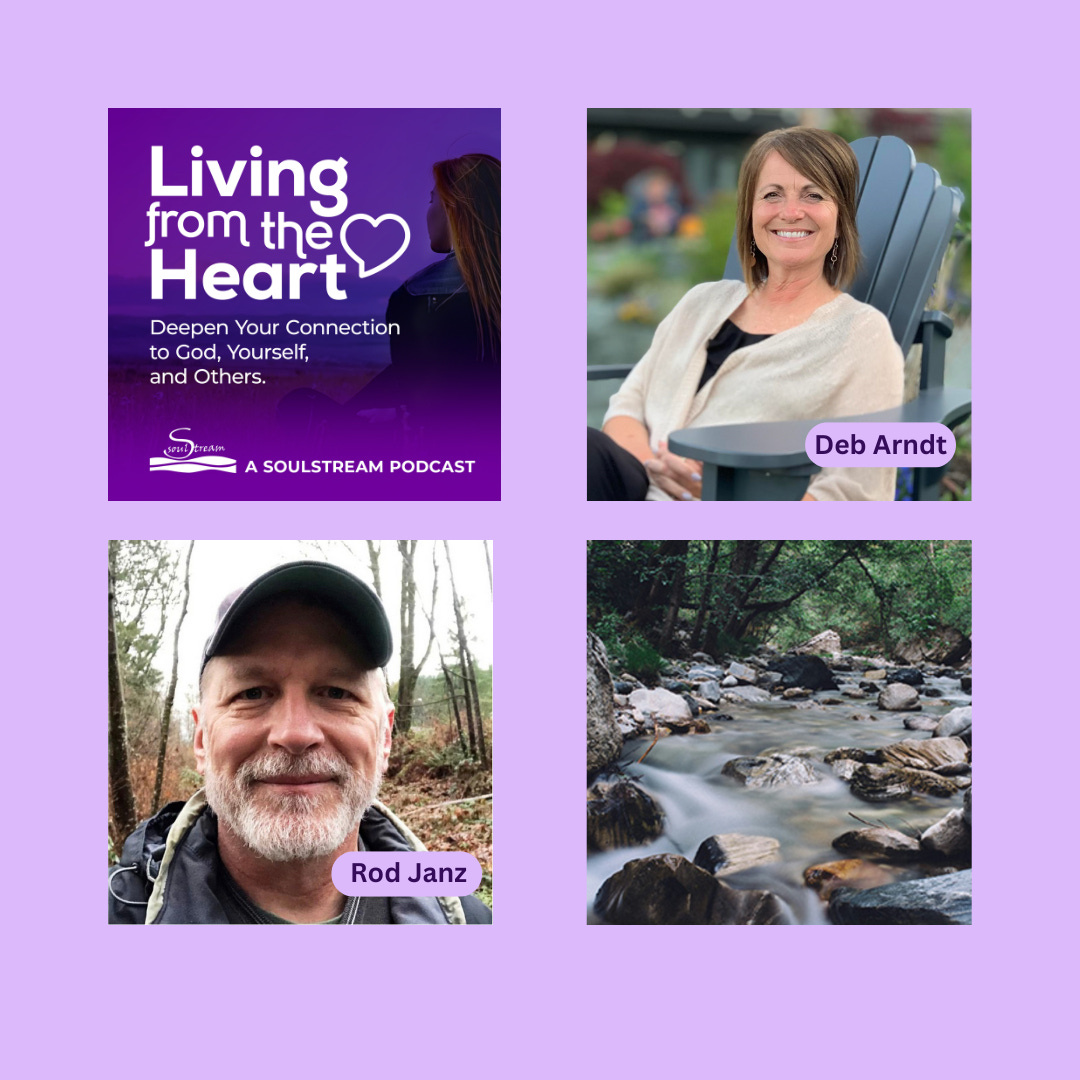
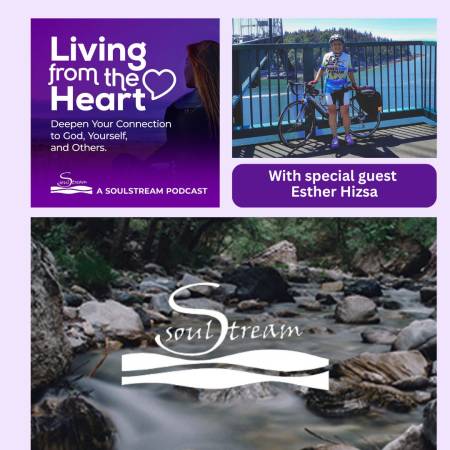
Recently, I had the wonderful opportunity of being interviewed by my friend and colleague Deb Arndt, for the second episode of the Living from the Heart podcast. In it, I shared my experiences of living from the heart and receiving God’s love.
To listen to the podcast click here.
Would you like a taste of Living from the Heart?
Join my friends and colleagues Maureen and Brent for a morning retreat online
Saturday, May 25. Register here.
You can also catch their interview here.
Here is a tidied-up transcript of Living from the Heart Podcast, Episode 2: Esther Hizsa.
Rod: Welcome to the Living from the Heart podcast, presented by SoulStream, where we explore contemplative practices, spiritual growth, and living authentically. To learn more about SoulStream, visit soulstream.org.
Deb: Well, welcome to Living from the Heart, a Soul Stream podcast. A podcast, an opportunity to explore this idea of living from the heart and our contemplative lives and how we opened in the midst of what is real for us. And today, I’m so delighted to have an opportunity to be here with Esther, my
friend and colleague. She’s a spiritual director, and she’s a retreat leader, and she’s a writer. She’s co-facilitator of SoulStream’s course called Living from the Heart. She companions people in the Ignatian Spiritual Exercises. In addition to that, Esther is a grandmother and a mother and a wife. She’s been married for, I don’t know, it’s over 40 years for sure.
Esther: 45 this year.
Deb: 45 years this year. So that’s to a wonderful man named Fred who I’ve also had the joy of meeting and spending time with. They live in Burnaby. And I’m often inspired by Esther happening to mention that she, I don’t know, rode her bike to Horseshoe Bay to take the ferry over to Bowen Island. So she is an active outdoors person who enjoys much of what that brings to her life.
Esther is the author of three books and of a blog, and we may chat a little bit more about that in the podcast. That’s definitely possible. But Esther, welcome here today. Thanks so much, Deb. It’s great to be here and to be interviewed by somebody who knows me well and has been a big part of my journey of living from the heart.
Yeah, actually, maybe let’s start there, because I was also reflecting on that a little bit, you know, having read your books and know little pieces here and there, but also more than what’s in the books, know the experiences from this opportunity of having shared some of them with you and walked along the way. Tell me a little bit about how relationships have supported you on the journey of living from the heart.
Esther: Oh, wow. Okay. Relationships, that’s…
Deb: I know, I’m just deep-dived right in. We’ll go back to the first question, but it just felt like such a…
Esther: No, no, it’s good. It’s good.
Deb: In a way, yeah.
Esther: I think relationships have been, are the places in which we can be deeply loved and deeply wounded. And my journey of living from the heart, you know, we share our stories at Living from the Heart. have been of both deep wounding and deep loving and I think in relationships, like I’ve had with you and Jeff and others in SoulStream, and with Fred, to be loved and cared for has been one way which I’ve experienced God’s love through other people where I can, I can be myself and not be judged, accepted, have compassion. Yeah. So those, um. that’s been really healing for me and, and, formational in how I’ve been able to be with other people. When I write about how I’m, I just, I just keep thinking about when I, when I started as a facilitator in living from the heart. And I thought, oh, this is going fine. And then it’s like, and then I feel like, oh, no, I keep messing up. I keep messing up. And then we talk about it. But it’s like there was acceptance and there was like, oh well and we move on and I realized wow this is what it’s like to be in a real relationship where you’re not expected to be perfect you’re received as you are and being vulnerable and saying really I’m really worried about this is not something that’s going to be counted against me yeah but appreciated yeah yeah
Deb: Yeah, thanks for what you named there. I just find myself feeling the goodness of doing this interview, this podcast with you, from that place of that kind of, yeah, you also and the relationship we share and the way in which I love you, but we can, you know, we can be the fullness of who we are. That in a way returns us home. Relationships seem to be the place for me that can kind of pull me outside of myself, but then at the same time, they’re the very pathway that helped me return to my center and core. And I hear that in white, you’re describing too. So yeah, thanks so much for that.
It’s probably helpful to give a little space to talk about just what does living from the heart mean to you? You know, we do refer to the chorus that’s all the members, which is called that. But in many ways, this podcast is, is much more, it’s not just about the course. It’s about what does this idea, this concept, this way of being that we refer to as living from the heart. What does that even mean to you? Yeah.
Esther: I think for me it’s really listening to and embodying that inner voice of love within us. That inner voice of God’s love within us. And knowing that nothing ever separates us from it. And living more and more deeply into that. And I was thinking about it and I thought how that impacts my life. And it impacts my life in two ways. And one way is that. We are always affected by our ability to choose, our freedom to choose is affected by things that happen to us that we can’t control. So the weather, illness, the way people treat us, you name it, all these things that happen that happen to us. And when those things happen to us and there’s a change, it can be really hard. It can be scary. And so this inner voice of love is there going, I’m right here. I’ll walk with you through this.
I’ll hold your hand and I’ll even help you find life. Yeah. So, so there’s, there’s that. And then, um, and, and I experienced that the summer when, when, um, my mom got diagnosed with cancer and then all of a sudden her symptoms were like taking her into hospital and she’s a caregiver for my dad and it just escalated so quickly. And so the life of independence that Fred and I had all of a sudden was shifted dramatically.
And to feel like God was with me in, okay, the next step and the next step and the next step was really, really helpful. And then the gifts that came out of that, the relationships I have with my siblings. I talked about early wounding. Here’s God healing those wounds. Where I can be with my siblings and really believe that they love me. That I could never believe for a long time because that was too scary. Yeah. So there’s these forces outside of you. And then there’s also the forces inside of us that…that robbed my freedom to choose. So fear, anxiety, false beliefs. And so this inner voice of love, God inside me that’s going with compassion again, giving me more. This is really hard. Not judging me. Oh, you should be over that by now. That’s never gone. That’s some other voice. So God going, yeah, this is hard. This is hard when you have anxiety or you’re afraid. And so this love that just keeps coming eventually frees me so that I can make more choices that I would like to make. I’m not stuck in that place. It doesn’t happen overnight. But it’s this love that meets me where I am, doesn’t tell me to pull up my socks, just loves me along. And then one day, I wake up and go, I think I can do that. Feel more comfortable in my own skin. That’s how I’ve experienced living from the heart or the contemplative life.
Deb: Yeah, I love how you make room for this sense that there’s both external and internal, and they’re having interplay too. But from this place of paying attention, from this center of love. Slowly, gradually, not in a linear line, at least in my own life. We get to experience and know and find what it’s like to live from this place of greater freedom and awareness, love.
Deb: Can you just how would you differentiate in this phrase living from the heart and what you’re describing from, say, people who might look at the heart as just like as the emotional center or if we’re talking about our heart, we’re just talking about the, you know, emotions. How would you sort of hold that perspective?
Esther: That’s a good question. Well, the heart, my understanding of living from the heart is it’s that bigger description of the heart that you get from the biblical understanding of it, the heart.
That it’s all of who we are. It’s not just our emotions. It’s our thoughts. It’s our bodies. It’s our experience. It’s all of those things. And you’re listening deeply to all your inner, what you might call inner movements of what’s going on inside you. So it’s an interaction between what you’re feeling what how your body’s reaction reacting and your thoughts as well
Deb: yeah It’s like yeah in my experience kind of a place of integration
Esther: yes
Deb: All these things are kind of present there. It doesn’t mean I am always even aware of that or that I live from that place of integration but that’s what the heart of living from the heart we’re talking about that.
Esther: Yeah right
Deb: Yeah I appreciate that yeah
Esther: It’s like a deeper place so when you when I first, you know, something impacts me and then I think about it from here I go you know oh oh that would be you know I don’t know about that and then listening deeper and then listening deeper to and it’s like your life it’s like you’re getting okay what do you what what’s going on over here what’s going on over there yeah you come to a place of oh okay yeah. Now all of it’s been heard. What do I want to do? Yeah.
Deb: And all of it’s been accepted and seen. Yeah. Yeah. Something that makes room for it differently than feeling like we have to eliminate something. I heard from someone a phrase around, it feels like it’s more illumination than elimination. We spend a lot of our life wanting to eliminate things that are difficult or feelings we don’t enjoy or perspectives that we know are limiting or the lack of freedom or whatever. And yet it seems like it’s part of letting love’s light, letting God’s light come in and illuminate those things. And that’s where a shift, a deeper shift happens and healing and transformation take place. Yeah. A lovely image. Yeah. Yeah.
Esther: It’s so gentle and soft and kind like I know whenever you know sometimes you think I want to do God’s will and it feels like you’re being shoved into some other picture of what you should be then I never experienced love God’s love like that. It’s usually more you know it’s like how are we making room for all of these things.
Deb: Well, you know, in that sense of this being a journey then and this understanding and the movement, and you described a little bit even how this has shown up in your personal life in the last while and how it’s shifted something about your relationship with God, knowing your, you know, your teachings. Maybe, I mean, if you’ve been married 45 years, I’m assuming you’ve got to be up there a little bit. Even if you were a child bride, you’ve got to be up there a little bit. There’s a trajectory of your life.
Esther: Yes.
Deb: I’m wondering if you can kind of just comment on the kinds of touchstones that have been part of that trajectory of where you find yourself now in this journey. And maybe just a few that rise up in you.
Esther: Yeah. And those are the things that I like to write about. Touchstones, because they’re so special to me. I think one of the things that stands out for me was when I was about five years old. And my mom would drive us into town for my older brother and sister to get accordion lessons. And she’d go to the delicatessen and get the, you know, my parents are Swiss, so they get the, you know, the cheese and the sausage and the fresh bread and everything. And I’d go with her like this little kid. And I wasn’t old enough to take accordion lessons. And yeah, but so, or actually I never did, but that’s okay.
Deb: You’re glad about that. I don’t know.
Esther: I’m completely fine with that. Anyway, and then she said, wait here while I get your brother and sister. And I’m waiting by the car, waiting. And it’s just like sunny day. And I’m like, I start like any little kid does. I started swinging around this lamppost and singing a song. And I started to sing, Jesus loves me this I know for the Bible tells me so. I heard it in Sunday school. And it was this moment where I felt like I wasn’t waiting to come home. I wasn’t waiting for my mom. I felt like I had come home to somebody that was wonderful and cared for me, this Jesus who loved me. I had a sense of God being there with me in that moment and just being home and being loved and far, far away from the voices that sent us. Because even at that age, I felt like something was wrong. Or I better watch what I’m doing, you know. But that was, that’s not what I felt. That was my first, I think, moment that I can name where I really experienced God’s love for me personally. Yeah. Yeah. Deb: Yeah. Almost you can feel it again now. I think as you tell it, I can see and feel that. But also in my own body, I just feel that. It’s an interesting image to use what you just used as home. Would you consider home as kind of an image for living from the heart that we were talking about?
Esther: Yes, I think that’s a good one. I think it’s a good one. You know, it’s interesting when you mention that. So my dad’s 95, and his health has deteriorated in the last little while. I mean, a few months ago he was using a walker. Now he’s using a wheelchair. And, you know, he doesn’t talk much about his faith, and he’s scared. You know, and sometimes it comes out. It’s been coming out in dreams, and he tells me about these dreams. And I just got the sense, this inner knowing that I bet I bet that God in God’s love is trying to give him touchstones for what he can expect when he goes “home”
And, and, and so I, he was telling me about this, this dream where it was kind of like those frantic dreams where you feel like you haven’t done enough and it’s never full and, and you could see his, his body. And I, I want to give him something that will help ground him. And so I said to him, “Hey, can you remember, well, if you could say, what was your favourite moment in your life?”
And he thought for a while and he says, “Well, I’ll never forget when you guys were little, we were working in the cheese factory and it was Christmas Eve. I was coming around the cheese factory and I saw the house and it was lit.” And back then, this tells you how old I am, that there were candles lit on the tree and he could see them through the window I’ve never heard my dad talk like this before. And he said, “and I was coming home,” and these were his words, “to someone who was on my side.” Don’t you love it?
Deb: Oh, yeah.
Esther: And then he said, “to my wife and to my kids.” And there was the snow and there was a dark night. You know, it was just this beautiful picture. And my mom was listening to this. And I realized this is a memory that God has brought back to him. Because he’s going, this is what it’s going to feel like. I was like, the spiritual director in me was going, “So Dad. And you know…” It went right over his [head], what? Yeah, well, but it’s okay it’s okay and that moment like when you talk about home and coming home and now like I mean it just I just like like it was just like all this all this unfolding that you just feel like there’s God going, there’s Love going [saying], “Here I am. Here I am for your dad.”
Deb: Yeah. Yeah.
Esther: For you.
Deb: I love that. Yeah. Let me pull to someone, as your dad put it, who’s on my side. And I think about this living with heart journey. I’m coming home. To the one who is, to the one who says good, loving, about me, you know, to the one who wants me to live and know my belovedness from that place. Yeah, it’s great. It’s such a great dream. And it’s okay on the spiritual direction stuff. I know that he’d already received what he needed to. Yeah, yeah. Yeah, yeah.
Deb: You know, so much of this journey seems to include a kind of cultivating vulnerability and authenticity, like the being real with what is, the opening and tender, rawness, vulnerability to what is actually true and real for us, like what’s going on in us and everything. I’m wondering how you cultivate that. Exactly. How you have, and how you do, and what you notice about that journey.
Esther: Yeah, yeah. Well, and I’m glad you mentioned that because that is like really key. The living from the heart and the contemplative journey is to be more, to be authentic, to be able to be our authentic selves and to be vulnerable. And so I was thinking about how do I cultivate that? And one way I cultivate it is by participating. It’s like going into the shallow end of the pool, going places where it’s welcomed and it’s understood and it’s invited. So things like when we get together to plan Living from the Heart as facilitators, we always do a check-in. And so between the three of us, we’re sharing, you know, what’s going on for us and where it’s being received. So, or in gatherings, again, like Living from the Heart or contemplative mornings or gatherings there’s already a space where it’s invited where it’s held in where people aren’t going to judge you or fix you or you know at least I’ll try to hold back advice you know that kind of thing so it feels a bit simpler yeah so there are those places I so I like I like those places because I feel like I could I can practice not practice like to make it better but just it’s a safe place to get an experience of doing that and then to be open and vulnerable with other people where it’s welcomed. And the thing I noticed about it is sometimes I’ll go to share something with others and then I’ll stop and I’ll go, well, wait a minute, I’m not sure I want to share that because somebody might judge me. And I realized when I became aware of that, I have a choice. I can go, huh,
Well, I could share it or I could not share it. Maybe this one. Why do I want to share it? Or what’s keeping me from sharing it? And like this past weekend, we were invited to share moments where we noticed beauty or something. Or when we had a moment of like just a sense of God or whatever. And we were to write them on sticky notes and put them on the wall. And I went into the chapel.
And my mind was, I went to the chapel and I played a song on the sound system using data. I never used data because I was, you know, you’re a fear of scarcity, right? And so, I was so proud of myself and I enjoyed that moment and the freedom of it. And I went to put in my sticky note and I was like, oh, I don’t know, somebody might judge me. And I thought, well, maybe there are other people out there that are scared to use their data too. Maybe other people struggle with scarcity. And I thought, and I put it on the wall. So I love that I can notice the judgment that keeps me from being vulnerable and then make a choice of, show whether to share it or not and that often comes up in the practice of being bold as what I write on my blog yes often I will I’ll go so I’m thinking about every week I write something about what how I noticed God in my life that week and then I’ll go oh well this happened and it’s all nice good story that’s easy but then it’s like oh it’s when I had that argument oh it’s when yep
this other awful thing happened. And then I would, and then I, I kind of argue with God. Yeah. I don’t think I should write about that. And then of course, nothing else comes up to write about. And then it’s like, okay, I’m going to write about it. And then somehow, and then it’s this inner voice of love going, why don’t you just write it like this? And maybe you could, you know, you can word it in a way. Cause I don’t want to, I’m not wanting to out other people. I’m, it’s not my, I don’t want to, I don’t want to put something on my blog that other people will be hurt by or offended by, you know? So I want to be careful how I, what I say, what I say. So anyway, that’s the, that process has been, has been good of being a little bit more vulnerable. And that’s the number one people of the readers that read my blog say, they’ll say almost always, thank you for being vulnerable.
Deb: Yes, absolutely. Yeah. Yeah. Esther’s blog, for those of you listening who might not know what it’s called, An Everyday Pilgrim. You get up and read some of these kinds of stories that Esther’s referring to. And yes, I really echo that sense of you’re willing to be vulnerable. And some of what gives you, I don’t know, the capacity to do that or something is because you’ve walked that journey and you know both the gifts and also how this is part of your living from the heart, deepening, contemplative, centered, and beloved life.
Esther: Right.
Deb: The other thing that strikes me is often I get this sense of, and I think you’ve reflected on it too, that people will say to you, me too. Or sharing, you know, gives our own sense of like, I also have that, you know, and it might not be exactly the same, you know, like saying, well, I’m using data. Like, what a beautiful, you honoured your story by writing it. Well, it may not be exact story of someone else but this sense of that oh I sometimes operate of scarcity and when I’m freed from it I sometimes receive gifts that are so beautiful and full of joy and light and life and that’s what you’re giving people room for when you know when you enter into that
Your blog posts, you have turned them into three books. I happen to have them all right here. Stories of an Everyday Pilgrim. 2015, is that right?
Esther: Yeah, that’s what I wrote before I started the blog. So those ones are not on my blog.
Deb: Okay, okay.
Esther: And after that, I started building blog posts into books. Nice. Yeah, so the second one’s called Seed Cracked Open. Lovely volume as well. And then your third one.
as of now, anyway, as of yet, I should say, In the Heart of the Beloved. And again, such a beautiful copy.
Tell me a little bit about how the journey to choosing to put them in the book has also been part of your living from the heart journey.
Esther: Well, and I guess that’s really tied into my journey as a writer. And one of the beautiful things about the contemplative life and living from the heart is that love keeps inviting me to pay attention to my deepest desires.
And from when I was very young to writing was something that just made me come alive. I was writing poems and songs and I was like, Oh, 13 years old. And then, and then, um,
And then I just, like, then I had to do work things. I had to make a living. And, you know, I remember my mom saying to me, and she meant it to protect me. I know she did it. She’s a sweet, my mom’s sweet. She said, the only thing worse than being a writer is to become an actor. They don’t pay, right? And so… and so I kept always doing things that were more important. And so as my life went on, and I felt there were ways in which God opened me up, to do more writing, but it always got put on the back burner. First, you know, I become a nurse and then become a pastor and all that stuff. And there were always people to visit and things to organize and writing got shoved to the back. But eventually, so then in 2012, I was doing the retreat in Daily Life, The Ignatian Spiritual Exercise with Father Elton Fernandez.
And Father Elton is like very soft-spoken, quiet, kind, gentle. And when I told him, one of the stories that came out was what my mom said. I said, yeah, about the only thing worse than being a writer is to be an actor. And he laughed. And I’m like, I can’t believe you’re laughing. You know, this is the thing that really hurt me. And he said, oops, I’m very, very sorry. I didn’t say that out loud, of course. And what kind of thing? What?
It freed me. It was one of the steps along the way to go, you don’t have to listen to that. I don’t have to be held by that fear anymore, that fear that you won’t make enough money. And so it led me to let go of my job working in a church and to spend more time writing. And so I ended up leaving, working at a church in 2014. In 2015, I published my first book. Yeah so then I had way more time to do things I loved like spiritual direction and co-facilitating. I was with my friend that I walk with who is a counselor and she says, You are way happier.” Yeah because I was doing what I love.
Deb: I love how you see that journey as part of living more deeply into your deepest, your deeper, deepest hearts, we could call them, in this place, in this integrated place. So it’s an enlivening, and we could say fruitful, not in a productivity sense, but in a blossoming and effective kind of sense. I do really see that in the journey that you’ve been on. It’s beautiful that I’m holding and I’m through it.
Esther, you know, as we start to come to the end of our time here, and I mean, we could keep going for sure. There’s lots of things we could continue to explore. But I wonder what you would say to someone. They might be listening to this and they’re hearing your stories and exploring within themselves too what it might mean to live in the heart or from their heart’s desires. What might you offer to someone who, I don’t know, might be struggling or just feels like, I need something.
Help along the way, you know, as we all do. What might you offer?
Esther: I think I would encourage them to find a spiritual director and have somebody that they can share and talk about with their, about their, about life, about what’s going on for them, about their disappointments, their hopes, and have someone who can listen with love.
To have someone listen like that. Because, I mean, I was thinking about that too. You know, I thought, well, one of the things I would encourage people is to be honest with God. Talk openly with God. Talk openly with other people as you feel safe. But talking with a spiritual director kind of helps that out.
Deb: Yeah.
Esther: And I mean, I’ve been, I’ve had a spiritual director for probably 20 years now. And I mean, I wouldn’t, there are things that I say in spiritual direction. And then I think I’m just saying something that’s just a matter of fact. And then I say it and I burst into tears and I realize, oh man, and then we stop. And I realize how important that is.
And, and, and that’s a place to where I hear those places where I can, would God really love me here? And it’s not like my spiritual director says, well, I love you. That’s not, that’s not what happens. It’s, it’s the director holds space for me to hear God say, I love you here.
And so, I think that’s the first thing that I would I would say. And then the two other things I would say, which I probably everybody would guess I would say next is you might want to read my blog. Yeah. And take Living from the Heart. Yeah.
I’ve taken courses. I’ve got a degree at Regent College. All those things are really great. But if a person could only do one thing and you have a year off, take Living from the Heart because it’s so rich. It’s such a combination of community and time alone with God and reading books and engaging in papers and different ways of art and music and the body and in community with other people who are vulnerable. And as facilitators, we never come across as perfect, like we have it all together. It doesn’t take long before they see we don’t.
That’s right. And so to share from that place. And I think every time we lead, co-facilitate living from the heart and the concepts and the experience and a poem that we use or a song just sinks deeper in. It’s been so life-giving and anchoring for me. It’s a safe place to… What does it mean to bring your doubts, to bring all of what’s going on in your life?
I don’t know, you probably heard this too, where people start Living from the Heart. Maybe I shouldn’t say this, people will be afraid to take it, but, and then something goes wrong, you know, like, like a major life, something, they don’t stop taking the course, but then here they are in this community, here they are in this space. Oh, it’s like, God knew that was going to happen, prepared this loving full, right place for them to go through that. Not, I mean, that doesn’t happen all the time, but it can happen.
Deb: No, it can happen. There are these things in our lives that are held differently from that place and in the cohort and with the material and the group and in a community. Yeah, yeah. That’s so good. Well, if there are listeners interested in SoulStream’s Living from the Heart Course and can explore it on the web or I’m sure the link will be added for people to be able to access it. But thank you so much for the way in which you’ve given us you, yourself, your presence, your voice, your journey. It’s been as I knew it would be heartwarming and grounding. So it’s fun, which is always good.
And it reminds me, even as I listen to you, yeah, into this journey, deepened life from this place of knowing love and goodness and compassion and bearing witness to my own life from this place and entering into it. And so thank you so much, Esther. I’m delighted to have had this time with you. Yeah, me too. Yeah, look forward to when it might happen again. Yeah. Well. thanks so much.
Rod: Thank you for listening to this episode of Living from the Heart, a podcast presented by SoulStream. SoulStream is a dispersed contemplative community that fosters contemplative living and offers courses like Living from the Heart and the Art of Spiritual Direction. For more information, see soulstream.org. Take good care, and we’ll see you again soon.
Credits and References:
Photos of the bridge and of hands holding a stone heart by Irene Fennema. Used with permission.
© Esther Hizsa, An Everyday Pilgrim, 2024.
The unauthorized use and/or duplication of this material without permission from Esther Hizsa is prohibited. Excerpts and links may be used provided there is a link to the original content and credit is given as follows: © Esther Hizsa, An Everyday Pilgrim 2013-2024. http://www.estherhizsa.com














 An Everyday Pilgrim