The Standoff

Such a familiar place,
this standoff between
the part of me that wants to 
and
the part that doesn’t

I can list all the good reasons why I need to do this
but something in me has shut the door 
leans her body against it 
and yells, “Leave me alone.”

I can force the door open.
She isn’t very big, 
but she’s the master of sabotage
and eventually gets her way.

This leaves me no peace.
I really want to do this
and that wanting doesn’t go away.

Then one day, instead of giving in, forcing or pleading, 
I sit down on the other side of the door and rest my hand on it
–touching it touching her–
and softly ask, “Tell me what you’re feeling.”

“It’s too hard, this thing you want me to do.” 

“It’s hard,” I say, letting her know I’ve heard her.

“I don’t know how to do it. I don’t know if I can.”

“It’s hard,” I say again
and let myself feel what she feels.

As I do, the door opens a crack.

We remember a quote from Glennon Doyle, 
“We can do hard things.”

I feel a shift. 
I’m no longer two parts
but whole.

And I get up and do
the hard thing I want to do.

One day, a wise, old owl flew by and saw the little bird all alone looking sad. The old owl flew down next to the nest. When the little bird looked into the kind face of the big owl, something inside felt safe and right to ask, “What do I do?”

The old owl gently moved over next to the little bird and said, “When you grow quiet inside and listen to your body, what does it tell you needs listening to more than anything else?”

–Edwin M. McMahon, “The Little Bird Who Found Herself” in Rediscovering the Lost Body-Connection within Christian Spirituality by Edwin M. McMahon and Peter Campbell

Questions for your Lenten Journey

  • Where in your life do you feel like you are at a stand-off with yourself and unfree to do what you’d like to?
  • What happens as you grow quiet inside and listen? What do you feel in your body? What do you hear?
  • Notice what happens as you simply listen and keep that feeling company.
  • Is there a thought, image, memory or feeling that comes to mind? If so, what goes on for you as this symbol interacts with what is going on inside you?
  • Is there a shift? What do you notice in your body?
  • What grace has God given you?
Credits and References:
“DK” by Andy Simonds.Used with permission.
Quote by Glennon Doyle in Untamed
“The Open Door” by Eric Magnuson. Used with permission.
© Esther Hizsa, An Everyday Pilgrim, 2022.
Unauthorized use and/or duplication of this material without permission from Esther Hizsa is strictly prohibited. Excerpts and links may be used provided there is a link to the original content and credit is given as follows: © Esther Hizsa, An Everyday Pilgrim 2013-2022.  http://www.estherhizsa.com
Posted in ADHD, Lent, Poetry, Reflections | Tagged , , , , , , , , , , , , | Leave a comment

Left-Handed in a Right-Handed World

I do that, I thought. And that. And that sounds familiar. Unease, enlightenment, and caffeine gently pulsed in my veins.

When my friend referred to herself as neurodivergent, I reached out with a “me too” and suggested we get together for coffee. In our conversation, she referred to folks like herself who have ADHD or others, like me on the autism spectrum, as simply not the majority in the same way that left-handed people are in the minority.

“Do you know how many things are designed for right-handed people?” she said. “It’s infuriating.” 

She felt the unfairness of it. I heard that being neurodivergent was not bad or wrong or anything to be ashamed of. I heard: there’s nothing wrong with me; I’m just different. 

Now I was discovering another difference.

“Two years ago when I read that people on the autism spectrum often have ADHD as well, I couldn’t take it in. I didn’t want one more label,” I said to my friend, “but I experience much of what you’ve described.”

I wondered if many of the struggles I face daily are traits of ADHD, so I took an online test and checked every box. That led me to notice how often I get distracted, how hard it is to sit still and listen, and how accomplishing a task becomes impossible when I’m not motivated to do it. In re-reading and revising blog posts for my third book, I saw how often I’ve unknowingly done something that offended someone, and, as you read in a recent post, it keeps happening. 

The real eye-opener was when my friend told me that people with ADHD are hypersensitive to rejection. That made me want to cry. Repeatedly being blindsided with the discovery that I did something wrong again has imprinted the fear of rejection on my nervous system. I’ve experienced repetitive little traumas with no abusers, just people reacting and responding to my impulsive actions, my sin. 

As I awakened to the possibility that my hurtful actions didn’t stem from a moral or spiritual problem but a physical one, I felt angry at the way the Bible has been read and Christianity taught through the narrow lens of morality. I can see now that my Christian beliefs contributed to the denial that kept me from recognizing the traits of ADHD. I believed I was “normal” and that my messiness was because I didn’t value ordinary work. I thought I repeatedly misplaced things because I wasn’t present enough. I procrastinated doing things that were boring because I didn’t care enough about others. I fed my addictions to word games and food because I wanted to feel good more than I wanted God. I interrupt because I’m not patient. I watch the clock for meetings to end because I’m self-centred. 

I have learned to judge myself in all these ways. Meanwhile, I’m as guilty as a person who is left-handed, colour-blind or has to buy specialized shoes. Sheesh!

I’m angry and I’m grateful.

I’m grateful God doesn’t judge, despite what the Bible seems to say. I’m grateful to be in communities that celebrate diversity. I’m grateful for the work LGBTQ+ people and mental health advocates have done to destigmatize differences. I’m grateful for friends brave enough to share their stories of not fitting in and loved ones who listen. If it wasn’t for them I would still be beating myself up for not being good enough. 

But this revolutionary act of treating ourselves tenderly can begin to undo the aversive  of a lifetime.Tara Brach, Radical Acceptance: Embracing Your Life With the Heart of a Buddha

Questions for your Lenten Journey:

  • Notice what you struggle with on a daily basis. What would it be like to offer yourself compassion instead of judgment? What goes on for you when you hear God or a loved one says, “This is hard.”?
  • Sometimes people think that if they aren’t hard on themselves, they won’t improve, that acceptance means we resign ourselves to the belief that things will never change. Studies have shown that the opposite is true. When we accept ourselves and our situations with tenderness and compassion, we find the energy to make the changes we can.
  • What new ways of being come to mind as you treat yourself tenderly?
Credits and References:
“Birds on a Wire” by Julie Falk Used with permission.
“Western Scrub-Jay” by Jerry McFarland. Used with permission.
© Esther Hizsa, An Everyday Pilgrim, 2022.
Unauthorized use and/or duplication of this material without permission from Esther Hizsa is strictly prohibited. Excerpts and links may be used provided there is a link to the original content and credit is given as follows: © Esther Hizsa, An Everyday Pilgrim 2013-2022.  http://www.estherhizsa.com
Posted in ADHD, autism, community, compassion, Lent, Mindfulness, Reflections, Stories | Tagged , , , , , , , , , | Leave a comment

Certainty and Clarity

We are gathered in a circle,
and a question is
placed before us.

Memories come
vivid and sharp
of feeling
weighted by expectation
confined by shoulds
inadequate when I failed.

I sense  
a groaning, a churning
a pushing against
a wanting release.

I give words to my no
certain
that it’s the no 
we all need

until 

on the other side of the room
I hear a quiet
yes
in response
to the same question.

I see a smile.
I hear 
an opportunity taken
a wonder at what became possible
satisfaction
delight.

My experience, my feelings, my thoughts
are not theirs.

Thinking about it days later on a bike ride,
I stop at a light
and these words 
snap into place:
certainty isn’t
clarity.

I had a piece,
not the whole.

The piece is not the whole
yet the whole is not complete
without the piece.

In that sacred circle,
we held our yeses and our noes
and found a way forward
together. 


The interplay of two polarities calls forth a third, which is the “mediating” or “reconciling” principle between them. In contrast to a binary system, which finds stability in the balance of opposites, the ternary system stipulates a third force that emerges as the necessary mediation of these opposites and that in turn (and this is the really crucial point) generates a synthesis at a whole new levelIt is a dialectic whose resolution simultaneously creates a new realm of possibility.Cynthia Bourgeault, “The Third Way”

Questions for your Lenten journey:

  • What happens to you when you discover others have a different experience from yours?
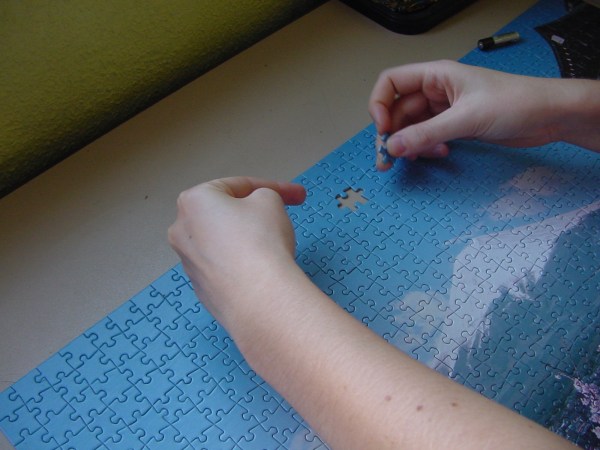
  • When you consider that your experience is only one piece of the puzzle, are you tempted to dismiss it as unimportant? Do you want to find another puzzle with pieces that match yours?
  • What’s it like to consider that we need to hear and value each other’s experiences in order to find a “third way”?
  • What might God be offering you as you notice and welcome what is arising in you now?
Credits and References:
“Puzzle” (only visible in banner) by Olga Berrios. Used with permission.
“Puzzle” by Olga Berrios. Used with permission.
“¡¡¡última pieza!!!” by Olga Berrios. Used with permission.
© Esther Hizsa, An Everyday Pilgrim, 2022.
Unauthorized use and/or duplication of this material without permission from Esther Hizsa is strictly prohibited. Excerpts and links may be used provided there is a link to the original content and credit is given as follows: © Esther Hizsa, An Everyday Pilgrim 2013-2022.  http://www.estherhizsa.com
Posted in community, Lent, Poetry, Reflections | Tagged , , , , , , , , , , | Leave a comment

It Isn’t That Easy

It isn’t that easy.

Jesus asks, “Are you coming?” I say, “Yes.” And then what?

I’m not instantly empowered like a superhero released from the kryptonite of salt and sugar, egoic desires, or negative thoughts. Taking Jesus’ hand won’t prevent me from sinking into self-criticism, making mistakes or experiencing fear or depression. He isn’t asking me to walk on the sea of my suffering unaffected by it.

Yet when I hear Jesus’ invitation to go with him, I do hear a we’re-going-to-do-this-thing grit. It isn’t a brute force I’m given that makes transformation possible. It’s courage to continue the journey of deepening awareness, grieving losses, receiving compassion, letting go, and not deserting myself when I can’t let go.

And that even sounds easier than it is. Deepening awareness involves recognizing how my patterns of behaviour affect others. This can evoke feelings of sadness, disappointment, regret and shame, recriminating thoughts, and fear of judgment and rejection. Grieving our losses isn’t a walk in the park either. Receiving compassion is hard when everything in me wants to stay behind a self-protective shield. And if I hear that Let It Go song one more time, I’m going to scream. 

“It isn’t simple. It isn’t easy,” I tell Jesus.

“It isn’t,” he replies softly.

Once again, he offers me his hand, and we take a step toward my suffering: my disappointment over a pattern of behaviour that hurt someone.

Instead of pushing my uncomfortable feelings away, I feel the cold waters of sadness rise over my ankles, my thighs, my chest. Waves of regret, insecurity and inadequacy peak and fall. But as Isaiah promised, I’m not swept away. I feel buoyed up. I’m able to hear from God and from another that I’m forgiven. That empowers me to forgive myself. 

I notice something else buoying me up. As I ruminate over what happened, I make a discovery that’s liberating.

I know that we’re all human and that on some level we all struggle with feeling inadequate. But I realize now, I didn’t really believe it.

Some people seem so together. They look together. They say the things I wished I’d thought of. They are wise, kind and loving. So I assumed they don’t struggle the way I do, that they can handle anything, that they’ve arrived. 

But they haven’t. My confirmation bias simply set aside moments I’ve witnessed and times they’ve told me about when that they feel as insecure as I do.

A friend said recently, “I can look like I have it all together when I don’t, and it doesn’t do me any favours.”

So here’s my take away. Nobody walks on water.

When Jesus says, “Are you coming?” he isn’t inviting me to put on my superhuman cape and be what I’m not. Yet, he’s determined to take me somewhere and do something miraculous with who I am.

When you pass through the waters,
    I will be with you;
and when you pass through the rivers,
    they will not sweep over you.
–Isaiah 43:2 (NIV)

Questions for your Lenten journey?

    • What do you hear when Jesus says, “Are you coming?”
    • Where do you think you’re headed?
    • What goes on for you when you consider allowing your feelings to be acknowledged and felt? 
    • Have you ever been swept away by them? Is something in you afraid of being swept away again? What’s it like to name that and receive Jesus’ compassion for you in that place.
Credits and References:
Superhero invasion by kath.Used with permission.
Father Damian by just.Luc. Used with permission
© Esther Hizsa, An Everyday Pilgrim, 2022.
Unauthorized use and/or duplication of this material without permission from Esther Hizsa is strictly prohibited. Excerpts and links may be used provided there is a link to the original content and credit is given as follows: © Esther Hizsa, An Everyday Pilgrim 2013-2022.  http://www.estherhizsa.com
Posted in compassion, Lent, Prayer, Reflections, Stories | Tagged , , , , , , , , , , | 1 Comment

Are You Coming?

I loved the look of satisfaction on Jesus’ face. We just fed five thousand men, plus women and children, with one boy’s lunch of bread and fish.

The scene continued to unfold in my imagination as I prayed with this gospel story while on retreat three years ago. I watched Jesus send the disciples off across the sea and then ascend the mountain to pray. He didn’t go far before he stopped and looked back at me. “Are you coming?”

“Oh yes!” I said and caught up to him.

Further up the mountain, we knelt and prayed. I heard his prayers. He heard mine. God listened intently, and the Holy Spirit enfolded us with love.

I didn’t want the moment to end. So I was a little annoyed when Jesus opened his eyes and gazed over his left shoulder to the Sea of Galilee.

Then I saw what he saw. A wind had come up and his friends were straining at the oars. They were exhausted and afraid.

In an instant, Jesus was up on his feet and booking it down the mountain. I could hardly keep up. We were running so fast and the mountain was so steep, I thought I might tumble ass over tea kettle.

When we got to the lake, Jesus didn’t hesitate. He sprinted across the water like a scene from The Shack. 

Then he stopped, turned around, and saw me stranded on the shore.

I will never forget that moment. He looked me in the eyes and once again asked, “Are you coming?”

That story lingers with me now as I find myself again standing on the shore of “I can’t.” 

I think of what I can’t do and list the many failures that prove that I’m right. I can’t stop overeating. I can’t be still. I can’t stop judging. I can’t stop worrying, obsessing, analyzing, fixing, and catastrophizing.

I can’t, Jesus. I can’t walk on water. I don’t want to fail again.

But Jesus doesn’t share my limiting beliefs and is unafraid of failure. He knows all about confirmation bias and is undeterred by my arguments.

He holds out his hand and says, “Are you coming?”

If you fight for your limitations, you get to keep them …
I promise you. You lift your head up, take a breath.
There’s a lot of great possibilities out there.
― Billy McMahon (played by Vince Vaughn) The Internship

Questions for your Lenten journey:

When we say something repeatedly to ourselves we come to believe it’s a fact. We know it’s true with the same conviction that we know we can’t walk on water. We even back up those beliefs with personal experiences that prove we’re right. We are often unaware of our confirmation bias which is “the tendency to look for information that supports, rather than rejects, one’s preconceptions, typically by interpreting evidence to confirm existing beliefs while rejecting or ignoring any conflicting data” (American Psychological Association).

    • As you listen to your thoughts today, what judgments about yourself do you hear?

    • What would it be like to imagine that these may not be true?

    • In 1 Corinthians 10:5, Paul says, “We demolish arguments and every pretension that sets itself up against the knowledge of God, and we take captive every thought to make it obedient to Christ.” What if we captured the thoughts we have about ourselves and shared them with Jesus?

    • We all have unchangeable limitations and accepting them helps us let go of old dreams and find new ones. Other limitations are ones we’ve unconsciously put on ourselves. As you talk with Jesus about your limitations, what encouragement do you receive? What new freedom is coming into view?

Credits and References:
Painting of Jesus walking on water by Daniel of Uranc 1433 CCO Public Domain.
Image of beach from pxhere. CCO Public Domain.
© Esther Hizsa, An Everyday Pilgrim, 2022.
Unauthorized use and/or duplication of this material without permission from Esther Hizsa is strictly prohibited. Excerpts and links may be used provided there is a link to the original content and credit is given as follows: © Esther Hizsa, An Everyday Pilgrim 2013-2022.  http://www.estherhizsa.com.
Posted in compassion, Ignatian Spirituality, Lent, Mindfulness, Mystical, Overeating, Prayer, Praying with the Imagination, Reflections, Stories | Tagged , , , , , , | 3 Comments

I Am Fed

For me, church is often one long exercise of trying to stay present. Multiple times, my mind drifts off like a balloon rising far above the hymns, prayers, and readings. I find it again caught in a zephyr of thoughts that seemed unimportant an hour ago. 

I pull the string down and coil it around my fingers. I hold my bouncing mind securely and open myself to receive an insight or image that might feed the hunger within. 

The sermon is a little easier. Today, Claude, our student priest, reminds us of Jesus’ words, “Blessed are the poor.” The poor, I hear Claude say, are those who need to rely on God–for everything. 

While I clean up the kitchen after supper, I listen to an On Being podcast. Sharon Salzberg tells Krista Tippet that her spiritual journey began when she heard, “There’s suffering in life. It’s not just you. You don’t have to feel aberrant and alone and weird. It’s a part of life, and you belong.” 

“It’s one of life’s big mysteries to me,” Salzberg says, “that we don’t talk to each other about the most common things, like the fact that we wake up in the morning feeling confused and scared and full of self-doubt. The miracle is, when someone finally names it, that’s so liberating.”

In the night, I wake for the third time and try to get back to sleep, I become aware of the jumble of disconcerting thoughts in my head. I feel confused, scared and full of self-doubt. I see how these feelings pull me up and out into a zephyr of catastrophizing. Then I hear Sharon’s compassionate voice. Of course you have these thoughts. We all do.

I hear Claude. We are all poor and need God for everything. 

With each breath, I reel myself back.

I need you, I inhale

I’m here, God exhales in me.

The next morning, I go to worship again. This time, it’s morning prayers on Zoom with my SoulStream community. In it, there’s a poem by Mary Oliver. In the poem, is an image illustrating what I just experienced.

This morning the redbirds’ eggs
have hatched and already the chicks
are chirping for food. They don’t
know where it’s coming from, they
just keep shouting, “More! More!”

Something in me is like a newly hatched bird, vulnerable and needy. Something in me fears if I don’t get what I need, I will die. So I open my grotesquely large mouth and cry, “More! More!”

Of course, you do, God says, sounding a lot like Sharon Salzberg. And God comes like a mother bird. She feeds this blessed, beloved part of me with words instead of worms that she’s picked up from the mouths of others.

I am fed.

This image has an empty alt attribute; its file name is newly_hatched_barn_swallow_hirundo_rustica_littlest_nestling_begging_baby_birds_nests_gaping.jpgThen he looked up at his disciples and said:
“Blessed are you who are poor,

for yours is the kingdom of God.”
–Luke 6:20 (NRSV)

Reflection questions for your Lenten journey

      • How do you feel when you see and hear that needy part of yourself?
      • Imagine God coming close with compassion, understanding and acceptance. Linger there and notice what you sense in your body. What thoughts or feelings arise?
      • Take another moment to reflect: How has God come and fed you in the last 24 hours? What thoughts and feelings arise as you consider the “worms” God brought? 
      • Share your feelings honestly with God.
Credits and References:
Photo of mural of little girl and balloon from Pixabay. Creative commons.
Excerpt from “This Morning” by Mary Oliver (1935-2019) in Felicity.
Newly hatched Barn Swallow, (Hirundo rustica), youngest nestling begging by Kati Fleming, CC via Wikimedia Commons

© Esther Hizsa, An Everyday Pilgrim, 2022.
Unauthorized use and/or duplication of this material without permission from Esther Hizsa is strictly prohibited. Excerpts and links may be used provided there is a link to the original content and credit is given as follows: © Esther Hizsa, An Everyday Pilgrim 2013-2022.  http://www.estherhizsa.com
Posted in compassion, Poetry, Reflections, Stories | Tagged , , , , , , , , , , , , , , | 4 Comments

It’s Your Turn

For the past few months, I’ve been revising blog posts for my third book. I’ve hunkered down to do the grunt work of publishing: formatting, footnoting, acquiring permission from a photographer and poets, and designing the cover. I used to dream of being on Oprah’s reading list, selling millions of copies of my books, and letting others do this tedious work. Alas, I remain an everyday pilgrim.

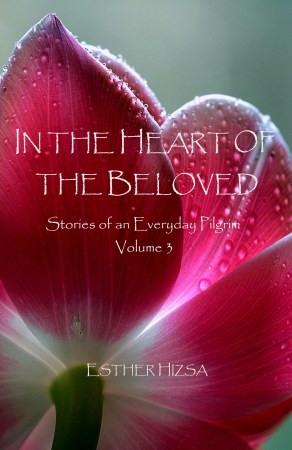
As I returned to the posts from 2015-16 contained in this book, I heard how often I was dogged by self-criticism and fear of rejection. Recently, friends who read my blog told me that I’ve changed. I’m much kinder to myself now. This caused some unease as I got reacquainted with the person that I was back then. I winced at how often she felt the weight of her faults, mistakes, and sin. Yet in every post, I read how she was tenderly invited back into the heart of the Beloved. I believe it was God meeting me in my shame that has enabled me now to live less disabled by it. I can join God in finding the part of me that feels disconnected and bring her back into wholeness. So I hold that old me with a deep gratitude and am pleased to honour her.

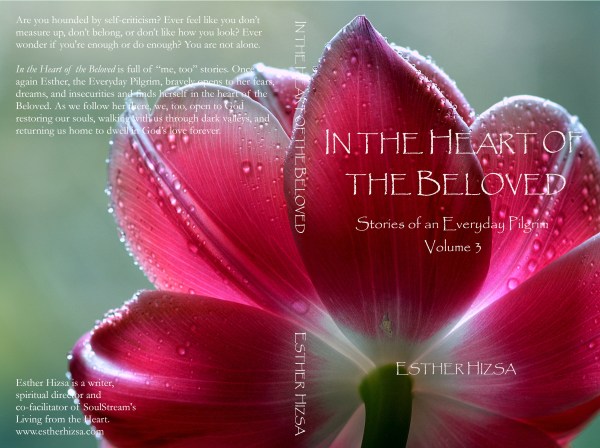
Here’s what I wrote for the back cover.

Are you hounded by self-criticism? Ever feel like you don’t measure up, don’t belong, or don’t like how you look? Do you wonder if you’re enough or do enough? You are not alone.

 In the Heart of the Beloved is full of “me, too” stories. Once again Esther, the Everyday Pilgrim, bravely opens to her fears, dreams, and insecurities and finds herself in the heart of the Beloved. As we follow her there, we, too, open to God restoring our souls, walking with us through dark valleys, and returning us home to dwell in God’s love forever.

In the Heart of the Beloved is getting closer to being released. But one thing is missing.

Below is a draft of the book’s cover. I fell in love with Sylvia Sassen’s photograph of this vibrant pink tulip some time ago and was delighted when she gave me permission to use it for my blog and book. See that space in the middle of the back cover? Often it’s reserved for famous people to say something positive about the author’s writing. But it seems appropriate to me that a book by an everyday pilgrim should be endorsed by other everyday pilgrims–aka you.

Would you consider sending me a sentence about how my writing has impacted you? I would like to print it on the back or inside the book.

Please send your words to me at aneverydaypilgrim@gmail.com or include them in the comment section below. I look forward to reading what you have to say.

Surely goodness and mercy will follow me
all the days of my life,
and I shall dwell in the heart of the Beloved forever.
Amen.

—Psalm 23:6  translated by Nan C. Merrill
Psalms for Praying: An Invitation to Wholeness

∗ ∗ ∗

Love Mischief for the World

I am grateful for the love mischief of photographer Sylvia Sassen and poet Nan Merrill (1931-2010). “I truly believe we stand on the brink of either a great darkness beyond imagining or, if humanity can awaken to our environmental, societal, institutional challenges, we can create a global garden where lasting peace, true justice, integrity, cooperation, freedom, and respect for all peoples and all of creation will reign,” Merrill said in 2002. “I believe that as individuals offer their ‘grain of sand’ gifts, a tide of growing goodwill and service will wash over the earth—a groundswell of renewed life for everyone. A naive dream, some may say, yet dreams come to fruition one step at a time. This is what motivates me to offer my life toward that dream; this is why I shall continue to write, honouring my gift as an offering as my heart dictates.”

What love mischief are you and God doing for the world?
Let me know and I will include it in an upcoming post.

Credits and References:
“Drops” by Sylvia Sassen. Used with permission.
Images of In the Heart of the Beloved book cover by Esther Hizsa. used with permission.
Posted in In the Heart of the Beloved, Reflections, Stories, Writing | Tagged , , , , , , , | Leave a comment

Five Hundred

five hundred posts
over almost nine years

one hundred and three months of
listening and feeling 
naming and holding
what I experience on my pilgrimage of life

weekly episodes of reality TV
honouring what is and what isn’t
sharing our common humanity
and the love mischief of God

five hundred posts and I’m not there yet
five hundred more and I still won’t be 
this is not a blog for those who just want to get “there”
it’s a blog for those who want to arrive
here

and be welcomed 
home

thanks for journeying with me

Blessed are those whose strength is in you,
whose hearts are set on pilgrimage.
–Psalm 84:5 (NIV)

∗ ∗ ∗

Love Mischief for the World

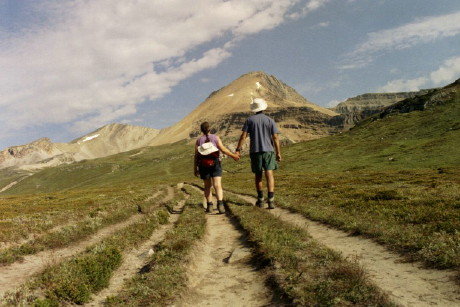
Did blogs exist back in 2004 when this picture was taken in Banff National Park? Cirque Peak was quite a hike. Fred was recovering from years of kidney dialysis post-transplant. I was grateful to be able to do the hike even if we did have to stop often and rest. I was grateful for my husband, my companion who would eventually become my weekly proofreader. The first gift he ever gave me was a pack of bubble gum which we couldn’t get in Bella Bella where we met and a copy of The Writer’s Market. Our forty-three years of love mischief with God has included many adventures including this one. I’m not so fond of bubble gum anymore. But I sure am fond of him. Thanks, Fred.

What love mischief are you and God doing for the world?
Let me know and I will include it in an upcoming post.

Credits and References:
Image of fireworks by Max Pixel. Creative Commons.
Photo of Gracie and me on the Lion’s Gate Bridge taken by a kind cyclist from Coquitlam, August 2021.
“Strolling with My Honey Up Cirque Peak, Banff National Park” by Fred Hizsa, August 2004. Used with permission.
Posted in Poetry, Reflections | Tagged , , , , , , , , | 4 Comments

Holding My Tender Heart


I’ve been afraid of rejection
my whole life.

Then I got rejected
twice
in one day.

My head told me
not to take it personally.
It doesn’t reflect badly
on them or me.
It’s for the best.

I continued on,
but when I looked back
my heart hadn’t moved.
She was still sitting at the corner
with a shocked look on her face,
feeling ashamed,
doubting her goodness.

“Oh, tender heart.”
I knelt down to wipe a tear from her cheek,
“I know,
I know this is hard.”

She’d wrapped her arms tightly
around her knees
as if she could protect herself
from what had already happened.

“I thought I belonged everywhere,”
she said. “That’s what you said God said.
But I don’t.
I don’t belong
there.”

“No. Not there.
They don’t want you there.
It’s true,” I said to my heart.

I stroked her back
and tucked her stray hair behind her ear.
“But you belong here,” I said.
“You belong to me.”

I picked her up and carried her
with shame, doubt and disappointment
tightly clutched in her hand.

Then, in the rocking rhythm of my body,
after a while
I felt her
soften
and heard her
sigh
as the hurt
slipped
from her tiny
fingers.


God tends his flock like a shepherd:
He gathers the lambs in his arms
and carries them close to his heart.

–Isaiah 40:11

∗ ∗ ∗

Love Mischief for the World

Coincidence? A friend sent me the Centre for Action and Contemplation‘s statement of belonging and anouther friend read it out at a meeting that same week. What would it be like for our communities of faith to be brave enough to create a litany of belonging, speak it out, and live by it? We are as beautifully diverse as these wild flowers. We all long to know that, in our differences, we are loved and accepted. That knowing needs to come from within ourselves, where we are one with God. We’re constantly on shaky ground if we rely on others for a sense of belonging. That said, how good it is when what we hear from God inside is echoed outside. May we be good echoers of God.

What love mischief are you and God doing for the world?
Let me know and I will include it in an upcoming post.

Credits and References:
Painting by William-Adolphe Bouguereau (November 30, 1825 – August 19, 1905) photo by Thomas Hawke.
Used with permission.
Moonbeams by Jessie Wilcox Smith (September 6, 1863 – May 3, 1935)
“Wild Flower Garden III” by Lex McKee. Used with permission.
© Esther Hizsa, An Everyday Pilgrim, 2022.
Unauthorized use and/or duplication of this material without permission from Esther Hizsa is strictly prohibited. Excerpts and links may be used provided there is a link to the original content and credit is given as follows: © Esther Hizsa, An Everyday Pilgrim 2013-2022.  http://www.estherhizsa.com
Posted in compassion, Poetry, Reflections | Tagged , , , , , , , , , , , , | Leave a comment

My Wild and Precious Life

Greg McKeown’s book Essentialism gave me the courage to schedule more time for writing. My third book won’t get published if I keep trying to fit it in around everything else.

“Everything else” includes my non-negotiables–spending time with family and friends, meditating and getting outside, preparing food and tidying up, reading, listening to podcasts and relaxing. It includes life-giving work–offering spiritual direction, preparing and co-facilitating contemplative experiences, and volunteer activities. It also includes meetings, sending and responding to emails and deciding moment by moment what I will say yes to and what I will say no to. 

“Only once you give yourself permission to stop trying to do it all, to stop saying yes to everyone, can you make your highest contribution towards the things that really matter,” writes McKeown.  As much as I want to believe I can fit it all in,  I can’t. Something loses out. Most often it’s my writing.

Two conflicting beliefs arose as I began making writing a priority: the belief that we all have a unique gift to offer the world and the belief that every moment is sacred–whether we are washing the dishes or creating a masterpiece. These represent two different postures: focused, forward movement and receptive rest.

Finding our purpose and living it out led Jesus to leave his quiet life as a carpenter and become an itinerant teacher, healer and Saviour. Sue Monk Kidd, in The Book of Longings invites us to live out of  “our largeness.”  Poet Mary Oliver asks, “Tell me, what is it you plan to do with your one wild and precious life?” Marie Forleo, author of Everything is Figureoutable says, “There has never been and never will be another you. You have a purpose–a very special gift that only you can bring to the world.”

I believe this is true, and it’s also true that our purpose isn’t our identity. I need to know who I am when I’m not writing. That’s the gift of the present moment. Each moment we can come home to ourselves, to who we are, an identity that is not achieved or dependent on what we do. Writing is a way I live out my purpose not who I am. I am a cherished child of God, loved and lovable, whole and complete, whether I write or whether I don’t..

However, if every moment is holy, and I am not what I do, I can easily assume that what I choose to do doesn’t matter. But it does. My discernment experience told me that while God is in everything and every moment, there are still choices to be made in how I spend that moment. 

It’s easy to see we need to make healthy, kind, and loving choices. But there are a lot of things we can do that are healthy, loving and kind, and we can’t do them all. In my recent discernment, God invited me to choose what is most aligned with who I am and what makes me most alive right now–even though it meant not going to Bible study, even though it meant disappointing others. Instead of going to Bible study, I’m offering a short series of weekly gatherings for my church on Zoom to reflect on four podcasts about compassion. 

As I open to the tension between these two postures of focused movement and receptive rest, I can appreciate both as necessary. I feel joy when I’m doing what I love and peace when I don’t have to do anything at all but breathe in the wonder of the moment. 

Joy is peace dancing. Peace is joy at rest.
― Frederick Brotherton Meyer

∗ ∗ ∗

Love Mischief for the World

“Essentialism is not about how to get more things done; it’s about how to get the right things done. It doesn’t mean just doing less for the sake of less either. It is about making the wisest possible investment of your time and energy in order to operate at our highest point of contribution by doing only what is essential.”–Greg McKeownEssentialism: The Disciplined Pursuit of Less.

What love mischief are you and God doing for the world?
Let me know and I will include it in an upcoming post.

Credits and References:
“Walking in leaves” photo from Pixabay in Creative Commons.
“‘Just right!’ she sighed.” by Steve Corey. Used with permission.
Posted in Mindfulness, Reflections, Writing | Tagged , , , , , , , , , , | 2 Comments